Showing posts with label Brisbane. Show all posts

Thursday, 10 March 2016

How logical fallacies affect transport planning decision making

Transport planning is a process and activity, performed usually at an organisational level that aims in defining a strategy, programs and actions to achieve desired goals, for solving complicated transport problems and commit resources as needed to implement these solutions.
The definition may sound a bit confusing, but transport planning as all kinds of planning is the most basic decision making support system. As such, transport planning is mainly a process of human thought and action. In our field, we come across people that are usually technically highly qualified but often miss the same level of training and experience in the fields of philosophy, logic and rhetoric.  This sometimes leads both transport planning consultants and public sector officers to unintentionally commit logical fallacies during the process of transport planning. If the public and stakeholder consultation and the risk analysis process of the planning activity are not robust, it may lead to catastrophic errors and waste of valuable resources.

A logical fallacy is the use of invalid or faulty reasoning, to construct an argument that appears sound and reasonable and ends up being deceptive. Aristotle was the first to study, analyse and categorise fallacies, so while the concept is not new it is still not widely known across transport planners. In my previous role, over a course of months, I presented 14 different logical fallacies and how they affect our consulting work but in this post I will present the four most common.

McNamara fallacy


The McNamara fallacy or quantitative fallacy is about transport planning and decision making based solely on quantitative analysis and ignoring qualitative variables and values. This usually occurs when there’s a pressure for “evidence based” practice either in transport policy or in planning. The desire to be able to prove the value of recommendations, leads transport planning practitioners to stick to survey numbers and modelling results and ignore other parameters of the analysis such as conclusions from the public and stakeholder consultation. Most importantly, it leads to ignoring the principles of planning theory and the established higher levels of planning (strategic regional and urban). The American social scientist and author Daniel Yankelovitch, listed the most usual misconceptions:
1. Measure whatever can be easily measured.
2. Disregard that which cannot be measured easily or to give it an arbitrary quantitative value.
3. Presume that which cannot be measured easily is not important or does not exist.
Big transport organisations such as Translink, that gather huge amounts of data daily are starting to understand that you cannot improve something just by consistently measuring it.

Sunk Cost Fallacy

Sunk cost fallacy, or Escalation of Commitment appears when transport planners recommend and justify increased transport infrastructure or services investment, in a decision based on the cumulative prior investment. This usually happens regardless of new evidence suggesting that the cost outweighs the expected benefit. Such investment may include spending more money on improving a transport system that was recently delivered but is hugely under-performing. Transport infrastructure has by nature high levels of sunk cost. You built a Light Rail system and then you’re almost obliged to support it for a long period or even expand it. Adding more lanes in an already congested motorway is a usual practice although over the years it has been obvious that induced demand keeps level of service (LOS) and delays at the same levels. This fallacy is so common that you will often hear expressions such as “Throwing good money after bad", or "In for a penny, in for a pound" around transport planning offices.
Usually sunk cost fallacious thinking occurs for a number of reasons:
1. Social, political or peer pressure
2. Psychological (usually in gambling but also involving office politics)
3. Project (past commitments especially in terms of higher level planning)

Planning Fallacy


The planning fallacy is the most obvious fallacy that affects transport planning. One would expect that experienced planning professionals would know and avoid this fallacy but a number of transport projects in the past had fallen victim to this. The West Connex freeway and tunnel and the North West Rail Link are just two examples that were just recently identified by the NSW Auditor-General. Planning fallacy is the natural tendency to be overly optimistic when estimating the time and cost that will take for a series of actions to be completed. Transport planning projects are affected by this fallacy when individual team members in the project planning face underestimate their own time for completion of their tasks. Usually this occurs despite the fact that these planners have previous experience of similar tasks taking longer than originally anticipated. Researches have provided a number of reasons for this behaviour that could be simplified as follows:
1. Wishful thinking (informal fallacy) when positive outcomes are thought to be more likely than negative outcomes
2. Self-serving bias (cognitive bias) – when successful outcomes are thought to be caused by the individual but negative outcomes to external factors
3. Future focus – tendency to forget the past, especially if it’s a failure and focus solely in the future, failing to take into account past experience for task cost and time to completion. 

Causal fallacy


Source: Stephen R. Johnson, Journal of Chemical Information and Modeling, 2008,
There’s a series of similar fallacies that fall under the general title of causal fallacy. In trying to analyse an incident or an event and understand what’s causing it, transport planners sometimes incorrectly identify the wrong parameters just because the statistical analysis shows a correlation. Simply because two events are happening together, this doesn't necessarily mean that the one causes the other. Similar to this, merely because one event is always followed by another, again it doesn't necessarily mean that the second event was caused by the first. There’s a famous saying among statisticians that “correlation doesn't mean causation” but this is something that is not always known among transport planning professionals. This fallacy is most common in transport modelling, where practitioners are usually very good at mathematics and statistics and they tend to rely on transport modelling software for their planning work. Analysis on how transport infrastructure affects urban development is another area that this fallacy appears quite often. Transport improvement is not always the cause of increased property development and never the only cause. With this fallacy there’s the risk to take it to the exact opposite extreme and think that correlation never implies causation. There are three conditions that can help understanding correlation and causation:
1. The data analysed and examined needs to be specific and consistent.
2. The causation needs to be plausible and pass the common sense test.
3. Understand the different types of relationship two variables may have other to causation.

Further reading – Sources


Bert van Wee, 2011, “Transport and Ethics: Ethics and the Evaluation of Transport Policies and Projects”, Edward Elgar Publishing
Helen Beebee, Christopher Hitchcock, Peter Menzies, 2012, The Oxford Handbook of Causation, Oxford University Press
This post was first published on LinkedIn Pulse.

Sunday, 7 December 2014

Innovation against congestion.


Congestion is one of the major problems that traffic engineers and planners are asked to deal with. In the past the most commonly proposed and adopted solution to congestion was the design and construction of new roads. New urban motorways and arterials shaped the way that our cities look and operate but failed to address the problem at the longer term since there was a parameter that was never thought off. Raging induced traffic soon clogged the new arterials or the added lanes on the urban motorways. Now, scientists even say that adding traffic lanes can even reduce overall performance.
And while this effect is not always recognised by politicians who seemed to prefer planning and designing for cars and not for people, the new political shift to cutting down state debt and deficit, meant that there were no longer huge amount of money for big transport infrastructure projects. But still the desire to deal with congestion remains as drivers lose time, waiting in stand still conditions while they are trying to get to and back from work every day. And since commuter traffic has two peaks within each day, going towards the city centre every morning and away from it towards the suburbs each afternoon, using the empty lanes and the surplus capacity on the opposite direction was a sensible thing that a few transport agencies tried to explore.
 
Source
Greek traffic police change the direction of a lane by placing “witches hats”. This is a measure that they use on rare occasions though; usually on long weekends and big public holidays like Easter and Christmas. This mass movement is called by the Greek media “the exodus” and “the return”.  Friday afternoon, highways that connect Athens and even Thessaloniki to the rest of Greece get an extra lane on the outbound directions and this is reversed on the day that everyone returns back home at the end of the long weekend. This is quite labour intensive and that’s why it’s not considered feasible for an everyday, commuter type solution.


There is a mechanical alternative to this treatment. It’s called “zipper” or barrier transfer machine as is the correct technical term. The zipper is a customised heavy vehicle used to transfer concrete lane dividers shifting a lane to be used for the opposite direction. Back in 2001, in the I-95 highway in Richmond, USA these machines were quite large and very slow moving. 

Source: Roads to the future
In 2013 zippers got a lot smaller and a lot quicker as shown in this video from I-15 in San Diego, USA.


The concrete barriers which can weigh almost half a tonne are linked together by metal connectors and are not anchored in the ground. This requirement creates a lot of constraints and limits its application in road sections that meet such conditions. Wide medians are excluded so are concrete barriers with lighting poles between them.  

Pacific Motorway, Tanah Merah, QLD
A simpler solution is having reversible lanes without any hard separation but rather than with just variable message signs like the one shifting the middle lane in Queens Road in Melbourne.

Queens Rd, Melbourne, Victoria
Innovative, clever solutions provide value for money but in order to achieve large scale benefits, a paradigm shift is necessary. Shifting away from car traffic and towards public transport and active travel and supporting this change with not only the funding but also the ingenuity that traffic engineers and planners have proven they possess.

Wednesday, 28 May 2014

Flying around Australia

Lately I've been busy with meetings around Australia and that meant I would have again the opportunity to observe transport systems around air travel.

My flight to Rockhampton was very early in the morning so I had to catch a taxi to Brisbane airport. I called the taxi company on the phone that I've found on the net and a few minutes later there was a Toyota Prius taxi waiting for me outside my house. The drive was a breeze as it was pre peak hour and the taxi driver asked me if I wanted to go via the tunnels which I decline due to tolls and low traffic.

Rockhampton airport is not big but it is well organised and modern. Rental cars are located just in front of the entrance to the terminal. Your other options are either taxi or a bus service to the city.

Rocky, as the locals and other Queenslanders call Rockhampton, is the beef capital of Australia. Beef is celebrated everywhere with numerous bull statuses around the city.


A few days later, I had to fly to Melbourne. This time, the flight was in the afternoon so I had some time to catch the Airtrain rather than a taxi, as they can be very expensive. For a cost of around $15 you arrive 20 minutes later at Brisbane Airport. The train service is of a high level with the only problem that it stops at 22:00 and leave the late night flights without coverage.

In Melbourne for around the same money and the same travel time you get to go to from Melbourne Airport to your hotel in Melbourne CBD by buses.  Skybus is an outstanding bus service that not only connects Tullamarine Airport to the CBD but also delivers you to your hotel door (or close) for the same price that takes the rest of the passengers just to Kings Cross station.


I was quite surprised when I arrived at Kings Cross station, as the lady that sold me the return ticket at the airport booth didn't say anything for the hotel part of the trip. I felt like I was at an asian capital. A number of small buses like the one in the picture above and drivers hanging outside the ticket office. I guess we do learn some things from our asian neighbours. The best part is that even on the return trip you can arrange to be collected outside your hotel in the CBD. And all these without really asking for hotel reservation papers or anything.

Transport systems that support city airports are a critical link to the city's overall transport system. For the visitors it's often the first impression that they get. A frequent and well operated public transport system that connects the airport to the city is crucial especially to cities that have a tourism focus.

Wednesday, 26 March 2014

AITPM@IPENZ - Last day. Ingenuity now more than ever.

Last day of the conference and I am happy to report on the conference proceedings back from Brisbane. I fully enjoyed my stay in Wellington but... give me Brisbane any day.

The conference day kicked of with keynote speaker Steven Newman, CEO of EROAD. I was hoping that Steven will speak about the work he did on road charging but Steven preferred to speak about future transport systems or as he called it super intelligent transport systems.

The second keynote speaker for the day was Rob Merrifield. Rob has worked for more than 50 years on road construction and management but his passion was always studying the historic development of transportation. From the Diolkos and the other ancient Greek rutways to the 1834 Newcastle upon Tyne railway and other tramway systems in England it seems that archeology takes more and more interest in transport systems of the past.


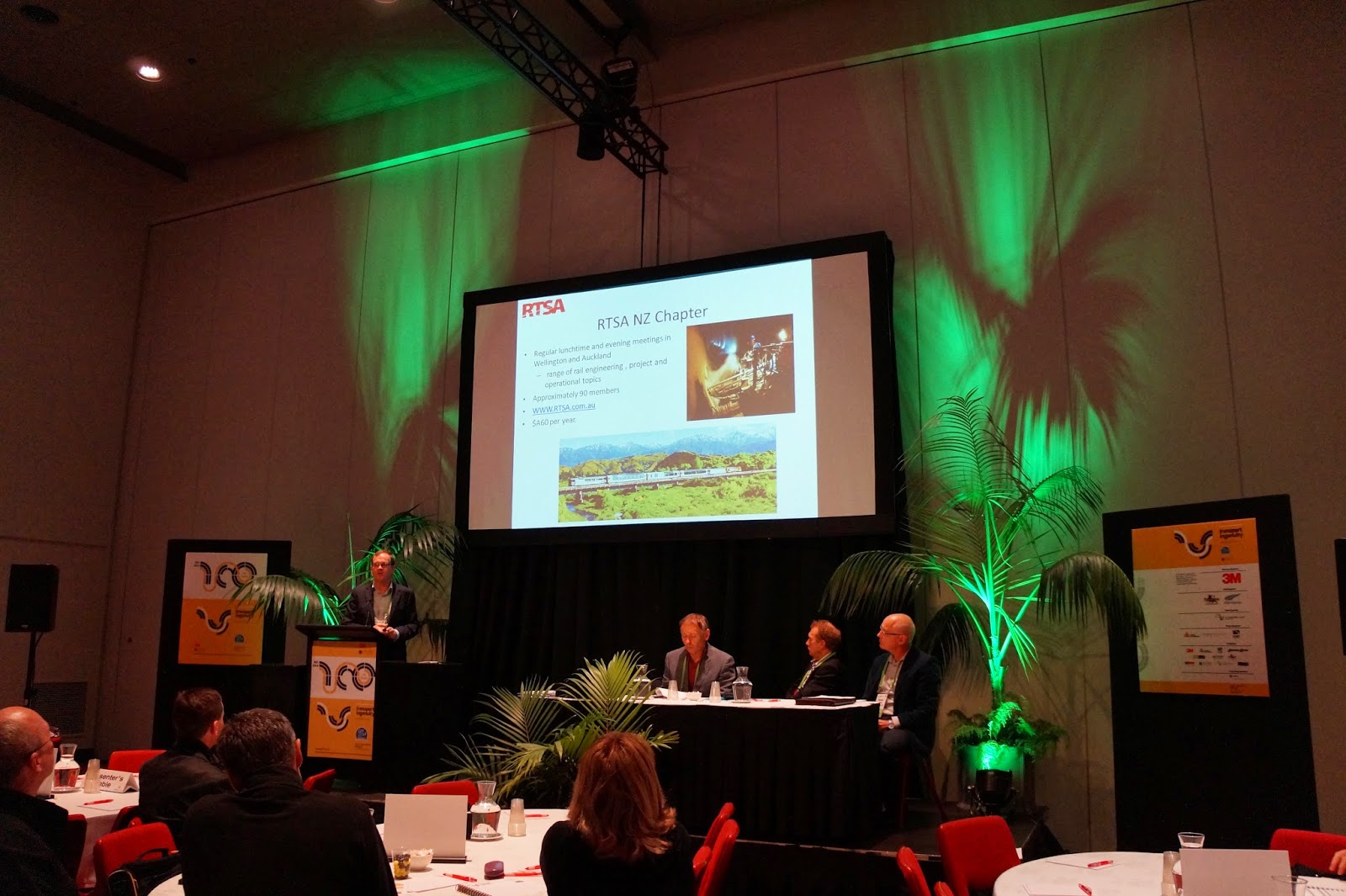
One of the morning streams was dedicated to the Railway Technical Society of Australasia a joint Technical Society of Engineers Australia and IPENZ New Zealand, formed to further the interests of the railway industry at large and its individual participants. With their upcoming conference CORE 2014 in Adelaide they are directed towards providing leadership for the facilitation and coordination of professionalism in the railway industry and the encouragement of member contributions to the application of railway technology and good management practices.


Michael McKeon from KiwiRai and then Randall Prestige from Target Railway Progress presented current and proposed New Zealand railway projects that will enable more efficient movement of freight and passengers across the country.


Overall the IPENZ Transportation Group 2014 conference was a great opportunity to learn about transport projects from the other side of Tasman sea. There are also  some good opportunities and ideas to enhance the collaboration between IPENZ and AITPM that are worth exploring the following days. I also found some good ideas that we can maybe adopt for our AITPM 2015 conference in Brisbane.

The quest for transport ingenuity is ongoing and more relevant now than ever in the history of 100 years of Engineers of New Zealand.

Sunday, 27 October 2013

Roadside memorials - safety warnings or hazards?

I was reading the other day about the decision of Queensland Motorways, the private company that operates some of the most important highways in the state, to remove roadside crash memorials from the Gateway and Logan motorways.

Although Qld Motorways stated that they understand that is a difficult and sensitive issue and that they tried to contact families that are related to the memorials, they remained firm to their decision not to allow or tolerate such memorials from now on.

Roadside memorial for a victim of the Pacific Highway. Photo: Dallas Kilponen DAK

The main reason behind the decision as quoted by Qld Motorways was road safety:
"Parking and walking along the motorway to maintain, establish or visit a memorial is an extremely unsafe activity, particularly with traffic moving at speeds of 100km/h" and "Roadside memorials present a visual destruction to drivers and create the potential for physical objects to harm road users by shifting onto the road surface." 

That article reminded me of all the roadside memorials in Greece, one of the countries that unfortunately has a high number of road crashes and road fatalities. In Greece most roadside crash memorials are like small churches while here in Queensland are usually just crosses or even a bunch of flowers taped to a post, a guard rail or a tree. Members of the family of the person or the people that were killed at the road crash maintain the memorial and in the case of miniature churches in Greece this is something that happens frequently as they have a small oil lamp that they keep lit.

Source:  Miniature churches in Greece

In other countries they erect different type of monuments and in some occasions they install a road safety warning sign. In a  bicycle specific practice widely known as "ghost bikes" people install white bicycles at the crash site.

Source: Roadside memorial blog
Source: Wikipedia
In Australia there was a big rise in roadside memorials since the 1990's. There is even a dedicated site that lists most of the Australian roadside memorials but whithout  much information for Qld.

This is yet another traffic issue that is controversial. According to the families that erect and maintain those memorials, they do more to combat the road toll than expensive government campaigns or flashing billboards. "They make everyone out on the roads think and slow down, because they represent a real loss. It makes more of an impact".

And this actually has merit and that is why erecting roadside memorials is not always illegal. Some of the US states like Colorado, Massachusetts, and Wisconsin ban such memorials. Different US states and world countries have different regulations regarding the memorials.In Queenland, Transport and Main Roads has a policy that regulates roadside memorials. According to it roadside memorials should be contained within the following dimensions:

    height 750mm
    width 500mm
    depth 400mm (below ground level).

In the interest of the safety of other road users and the safety of persons installing memorials, there are a number of locations where the placement of memorials is restricted. Examples of locations where memorials are not permitted include:

    motorways and freeways
    traffic islands
    medians
    roundabouts
    where they may interfere with any traffic control devices.

I hope sooner than later vehicle technology advances, driver education and investment in road infrastructure will make roadside memorials obsolete and part of human history. Until that day, families taking care of the memorials need to be cautius so there is no need to duplicate them.  Regardless of state or private company regulations, roadside memorials will be there to remind us that driving a car, a bike or any short of vehicle comes with risks and dangers.

Tuesday, 17 September 2013

Segways on the footpaths.

It's really funny that now that I'm working with heavy vehicles and dealing everyday with road access to some of the largest vehicles in Australia like ABB quads, the smallest of transportation vehicles caught my attention.


I am talking about Segways in Brisbane and electric bikes/scooters in the Gold Coast.  Just recently Queensland government announced that from 1 August 2013, approved Personal Mobility Devices (PMD) can be used on road related areas such as footpaths, bike paths and shared paths. At the moment Segway is the only PMD that has been approved but other similar devices like gyro-stabilised electric unicycles can be approved and until then can only be operated on private property.

There are certain conditions under which Segways are allowed to operate in Queensland. Those include among others the use of helmet (no surprises there), give way to pedestrians and having a warning device as a bell or horn. There is a speed restriction of 12km/h and you shouldn't be driving past a "PMD prohibited" sign.


Queensland police has adopted Segways on a 3 month trial for use on Brisbane's South Bank and Cairn's Esplanade. Officers are actually allowed to reach 20k/h when chasing a bad guy.


This whole PMD issue is not really new to Qld and Australia since mobility scooters, motorised disability wheelchairs and electric bicycles were allowed to travel on road and on the footpath for quite some time now. These vehicles need to achieve specific performance based standards and are limited to 200 Watt of power where the new PMD's don't have that limit. Segway seems to have far more power than that.


Other countries around the world allow Segways on the streets and footpaths under various conditions and contrary to the urban myth the inventor of Segway didn't die riding one of his inventions. 

And then, the other day while driving back from the beach at Surfers Paradise I saw a bunch of teenagers lane filtering and even moving from the pavement to the footpath on electric scooters. Those vehicles looked a lot like regular scooters although I noticed that they had pedals. It appears that they are available for hire without a drivers licence and they have less than 200 Watts of power.


They reminded me of my first vehicle the Honda Camino which I used to drive to school everyday between the ages of 16 and 17 back in Kavala Greece before I replaced it with the at the time very popular "ducks" Yamaha Townmate. They both had 50cc petrol engines and you needed a special drivers license issued by Greek Police to drive them.


As I said in an older blog post, I believe that scooters and even Personal Mobility Devices can provide better alternatives to urban travel than the car. And while I don't think that we will see a lot of Segways in the next years travelling on our footpaths it is certainly an idea worth exploring.  

Friday, 19 July 2013

User pays - user says. Is that right?

The last few years and especially after the global financial crisis or GFC as we call it here in Australia that we love our acronyms, a big part of the transport discussion is around financing and funding. Public-private partnerships (or PPP for the Aussies) and other more complicated financing tools or instruments are developed and used to keep funding transport projects in times that almost all countries are opting for austerity measures.


The first results of this new approach are not that encouraging. The last year the big discussion in Brisbane regarding transport and traffic was the failure of the big privately owned transport projects, the Clem Jones (CLEM7) and the Airport Link tunnels. The companies that invested in those projects failed financially and went into receivership. 

A Dart & Co
Inevitably the luck of funding and the failures of the new privately funded models fired up again the discussion about the fundamental funding issues:

Should transport infrastructure be founded by the state? Is it fair for example for a tax payer that doesn't own a car to pay for a new highway? Should someone that rides a bike to work and never uses public transport to contribute with his taxes to the subsidization of the bus and train network? Should transport companies that use an industrial road be responsible for the maintenance cost of the road that they are the most frequent users?

Infrastructure Australia which is a statutory body, established under the Infrastructure Australia Act 2008 and advises federal and state governments, investors and infrastructure owners on a wide range of issues like the country's current and future infrastructure needs, mechanisms for financing infrastructure investments, and policy, pricing and regulation and their impacts on investment took the discussion a step even further. In the latest annual report - the national infrastructure plan  they suggest that the user pays - user says model should be adopted. That means that not only the user should fund the infrastructure project by making a direct contribution but also in return the user will get a say on the level of service provided.

"A move to congestion charging will be needed if we are to reduce the growing economic burden of congestion and make best use of existing network infrastructure," Again this statement of the same report raises many questions as it is a totally different approach from the one major Australian cities were taking till now.

So does this mean no more new tolled transport infrastructure? Until today the thinking was, that a new road/ bridge/ tunnel that would reduce congestion and give people the option of shorter travel times would attract traffic despite the price of the tolls because people would gladly pay for the time saved. As it was proved not too many people would do that and most would prefer a longer and cheaper trip which in the case of Brisbane, would also be more pleasant (shinning and not dull). So, are we moving in a direction that tolls would be introduced in existing roads that face congestion in a congestion pricing scheme similar to London and Stockholm?

The Spectator

The debate started  a long time ago and would probably last for a few more years. I expect that in the near future we would start discussing even more innovative approaches like crowd funding. And maybe who knows some day someone would decide to build and maintain a bus or two just because that would give him the right to name the buses after his wife or daughter, the same way a video game production company gave donators the right to have game characters named after them.

Tuesday, 11 June 2013

Low Bridge or High Times?

One of the issues often underestimated in traffic engineering is that of vehicles' height. Low clearance bridges or overpasses cause all short of problems to traffic and transport. From major safety incidents to amenity problems to surrounding neighborhood. 


Just yesterday Europe and the world was shocked with the tragic crash of a double decker bus on a low clearance bridge in Munich, Germany that left 40 young people injured, one of them severely.


It surely made me wonder; was it the low overpass or was it the high times?

That bridge had a clearance of 3.4 m which is far less than the 4.3m Queensland and Australian Road Rules general regulation hight or the 4.4 m double decker bus regulation.

This 3.4m height though, is taller than the clearance of a number of railway overpasses throughout Brisbane wider area. There are a few that are less than 3.0 m and there is even the one over Colina Street, Wynnum that has a clearance of 1.9 m. 


Searching in the Internet for a list of vehicles' heights, I couldn't find a single page that all different vehicles are listed. That is because vehicle height is the one dimension that is far from standard. Truck manufacturers provide the various standard chassis and on top of them, they fit different types of truck bodies. Many of the truck bodies are custom made to fit different transport needs.

Even with container trucks, height is not standard. There are many types of containers that can reach up to 2.86m for the high cube one. With this height even if the container could move by itself without the need for a truck to carry it, it still couldn't make it under some of Brisbane's rail overpasses.

One of the major car rental companies on their truck rental website lists every truck's height but instead of the overall height they list just the cab height. 


Most of the in-car GPS navigator systems don't have a comprehensive list of all low clearance overpasses. I am afraid that even professional truck drivers are driving around without knowing the exact height of their vehicle. 

Rail infrastructure is usually very difficult to modify within a reasonable cost, especially in locations that the overpass is too close to the railway station like in Wynnum. Lowering the road surface underneath, wherever permitted by geology and storm water design, creates collateral damage to the wider area, with retaining walls creating a barrier for pedestrian movement.

The answer to these problems is usually detection systems and warning signs. Tunnel management authorities are leading the way in this field. And of course, transport planning should always try to find a suitable detour for the extraordinary transport of high loads.