A few weeks ago I had the pleasure to visit South Island New Zealand for a week of holidays. I flew to Queenstown by a direct flight from Brisbane and then from there I embarked on a seven days road trip around the southern part of the island. You can see my day to day itinerary on the map bellow:
The South Island is an amazing place with a big variety of breathtaking landscapes. Driving around the island is fairly relaxed due to most roads having little traffic and is also quite pleasurable as the road network is diverse in characteristics and not monotonous. Lots of curves of different radii, uphill and downhill sections and of course the magnificent road environment and landscape allows the driver to drive long distances without feeling bored or tired.
Mountainous sections and sections across the Alps, ocean side sections and sections across the fields, they are all worth having a look. Plenty of spots of interest along the way, provide opportunities to stop, rest, enjoy lookout views and observe wildlife and livestock.
There are a few very interesting aspects of the South Island New Zealand road network. One that stands out is the single lane bridges. Most of the bridges along the peripheral route that I followed, were single lane narrow bridges. With low levels of traffic and without the very long and very heavy vehicles that we have in Australia, single lane bridges seem to work just fine. Just a few of them are very long, and these ones have usually one or more pull-outs, so that you can pull your car aside if you happen to accidentally be on the bridge as another car is trying to cross it too.
One other very interesting aspect of the road network is the way New Zealanders do roadworks. I am not sure about the work health and safety statistics on roadwork sites, but it seems that they take a far more relaxed approach than Australia. Less people doing traffic control, use of automatic traffic lights to control one way traffic on roadworks sites and far less use of roadside protective barriers. The big debate about WH&S protection measures on roadworks sites and how those raise significantly the total cost may have an answer in a comparative analysis between the two countries.
But then again, looking at the picture above, maybe the solution for roadworks safety is somewhere in between the approach taken by the two countries.
My view on Mobility Management theory, principles, strategies, ideas and best practices. From the experience gained in Europe to the every day life in Australia. How can mobility management make our life in the cities better?
Monday, 6 April 2015
Monday, 23 February 2015
Moving around Fraser Island.
Cyclone Marcia was the reason that we had to cut our family trip up the Queensland
coast short. Unfortunately our visit to Agnes Water, 1770 and eventually LadyMusgrave Island at the southern end of the Great Barrier Reef will have to wait
for another time. But we managed to complete our first visit to Fraser Island.
The island’s native name is K'gari and it is a unique place listed as a UNESCO world heritage site that holds a significant environmental and cultural value. It is the world’s largest sand island, made up
of sand that Pacific Ocean currents carried from the rivers of Northern New
South Wales and Southern Queensland.
It is an
extremely beautiful place with a fairly unique and fascinating transport
system. You can get to Fraser Island either by a small ferry or by a small
plane. We chose to take the ferry from River Heads near Hervey Bay to Wanggoolba
Creek named Fraser Venture. The other options to arrive to Fraser Island were
to take a different ferry from River Heads to Kingfisher Bay or a ferry from
Inskip Point near Rainbow Beach to Hook Point at the southernmost point of the
island. All three ferries are very small and can carry only a small number of
cars and trucks.
To drive
around Fraser Island you need a 4WD and not just a 4WD but a fairly high
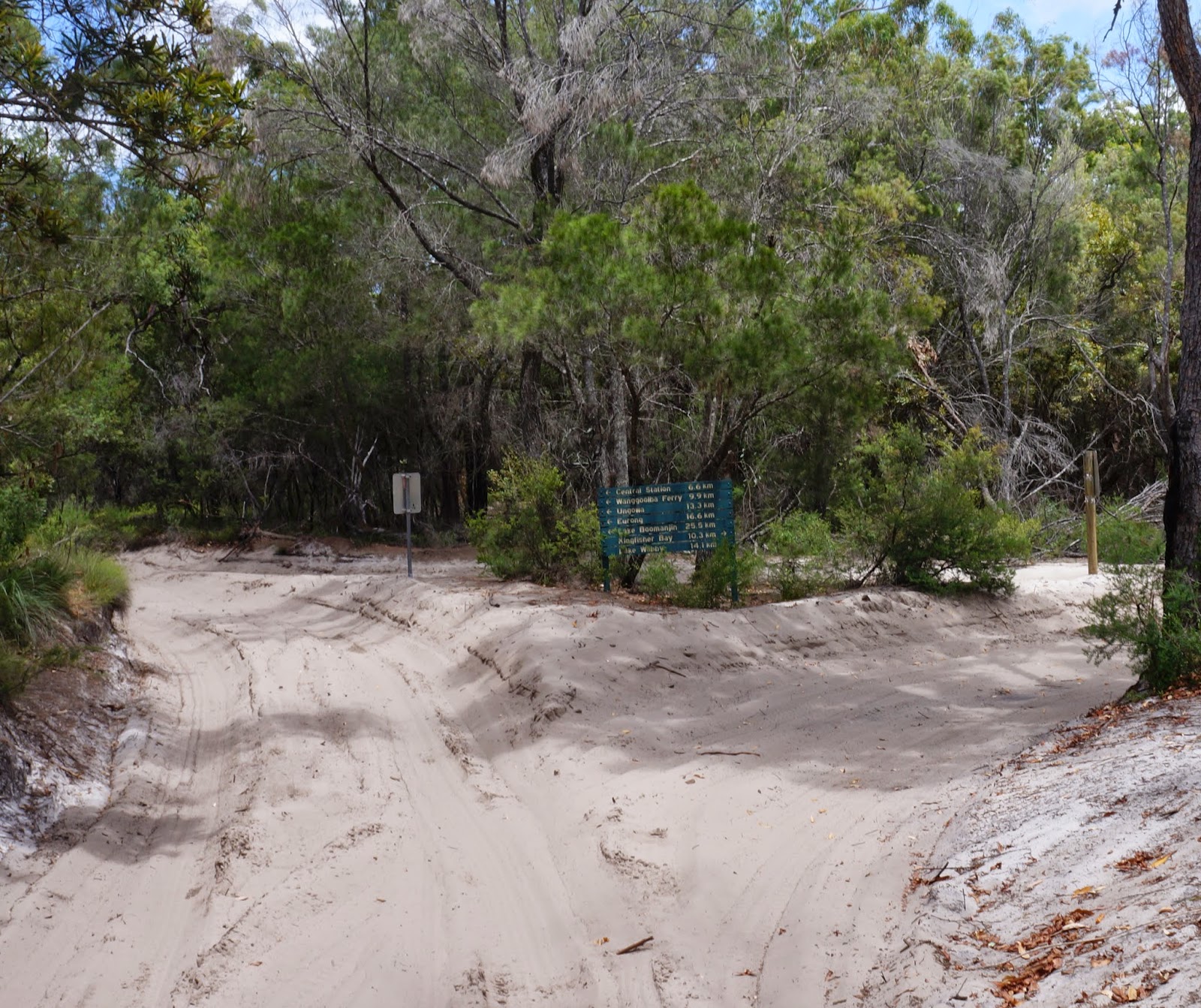
clearance 4WD with low range capacity and preferably new and wide tyres. You will also need a vehicle permit that can be purchased online or by phone. The road network in the island is all sand and
it is divided in two very different parts: Inland sand tracks and beach. Driving on them requires different vehicle
setup and specifically different tyre pressure and 4wd gear range settings. It
offers a very different driving experience, driving at different speeds and at
a different ride roughness.
Driving off
the ferry at Wanggoolba Creek we followed the sand track towards Central Station. Wanggoolba Creek was a Butchulla woman’s area and birthing place where
men were excluded. While the name usually refers to a train station, Central
Station is an old lodging village and the headquarters of forestry operations
from 1920 until the late 1950s. No matter how wide your 4WD tyres are, you need
to deflate them to around 20 psi (depending on the vehicle and tyre make). You
also need to engage low range before entering the sand tracks. We visited Fraser island outside the school holiday
season so traffic on the tracks was not too heavy and we avoided too many
encounters of opposing traffic on the narrow sections of the tracks. Driving on
sand tracks has a 30km/h speed limit and all other road rules apply. In
practice it is quite difficult to reach even that speed as most of the drive is
quite bumpy due to underground tree routes that give a wave like look along the
track.
Our next
stop after Central Station was Lake McKenzie or as is known by its Aboriginal
name Boorangoora. A sandy beach of almost pure silica gives an exotic –
paradise like look to the place. Next
stop from there was the eastern beach.
When
planning your trip to Fraser Island is good to know the tide times. Driving on
the beach is only safe two hours each side of the low tide. Driving two hours
each side of the high tide is extremely dangerous and lots of cars have been
taken by the Pacific Ocean. Arriving at Eurong you should re-inflate your tyres
to the suggested by the manufacturer pressure. Driving on the beach is much
more like driving on asphalt road. The magnificent 75 mile beach is one of the
island’s main attractions. The speed limit on the beach is 80kms/h but you have
to drive very cautiously and be aware of beach goers, deep washouts from creeks
flowing into the sea and light airplanes landing on that same beach that you
drive.
Of course in such a sensitive environment there are always concerns on whether the transport system of driving around in 4WD cars and buses is the most sustainable and eco-friendly solution. In the same time driving on the beach and on sand tracks has not been free of crashes. Turning the sand tracks into regular roads is next to impossible due to the distraction such a measure will bring to ecosystems and habitats. Even upgrading the existing tracks will attract more vehicle traffic, resulting in a spiral of more road degradation and more expensive maintenance. Ideas about alternative transport systems like a light rail system, have been tabled in the past but were never investigated in depth.
Labels:
4WD,
Agnes Water,
beach,
Cyclone Marcia,
Eurong,
Fraser Island,
Heritage listed,
Inskip Point,
Kingfisher bay,
Lake McKenzie,
light rail.,
River Heads,
sand tracks,
tide times,
transport system,
Unesco
Location:
Brisbane, Qld, Australia
Sunday, 7 December 2014
Innovation against congestion.
Congestion
is one of the major problems that traffic engineers and planners are asked to deal with. In the past the most
commonly proposed and adopted solution to congestion was the design and
construction of new roads. New urban motorways and arterials shaped the way
that our cities look and operate but failed to address the problem at the
longer term since there was a parameter that was never thought off. Raging
induced traffic soon clogged the new arterials or the added lanes on the urban
motorways. Now, scientists even say that adding traffic lanes can even reduce overall performance.
And while
this effect is not always recognised by politicians who seemed to prefer
planning and designing for cars and not for people, the new political shift to cutting
down state debt and deficit, meant that there were no longer huge amount of
money for big transport infrastructure projects. But still
the desire to deal with congestion remains as drivers lose time, waiting in
stand still conditions while they are trying to get to and back from work every
day. And since commuter traffic has two peaks within each day, going towards
the city centre every morning and away from it towards the suburbs each
afternoon, using the empty lanes and the surplus capacity on the opposite direction
was a sensible thing that a few transport agencies tried to explore.
![]() |
| Source |
Greek
traffic police change the direction of a lane by placing “witches hats”. This
is a measure that they use on rare occasions though; usually on long weekends
and big public holidays like Easter and Christmas. This mass movement is called
by the Greek media “the exodus” and “the return”. Friday afternoon, highways that connect Athens
and even Thessaloniki to the rest of Greece get an extra lane on the outbound
directions and this is reversed on the day that everyone returns back home at
the end of the long weekend. This is quite labour intensive and that’s why it’s
not considered feasible for an everyday, commuter type solution.
There is a mechanical
alternative to this treatment. It’s called “zipper” or barrier transfer machine
as is the correct technical term. The zipper is a customised heavy vehicle used
to transfer concrete lane dividers shifting a lane to be used for the opposite direction.
Back in 2001, in the I-95 highway in Richmond, USA these machines were quite large and very slow moving.
![]() |
| Source: Roads to the future |
In 2013 zippers got a lot smaller and a lot quicker as shown in this video from I-15 in San Diego, USA.
The concrete barriers which can weigh almost half a tonne are linked together
by metal connectors and are not anchored in the ground. This
requirement creates a lot of constraints and limits its application in road
sections that meet such conditions. Wide medians are excluded so are concrete
barriers with lighting poles between them.
![]() |
| Pacific Motorway, Tanah Merah, QLD |
A simpler solution is having reversible lanes without any hard separation but rather than with just variable message signs like the one shifting the middle lane in Queens Road in Melbourne.
![]() |
| Queens Rd, Melbourne, Victoria |
Innovative, clever solutions provide value for money but in order to achieve large scale benefits, a paradigm shift is necessary. Shifting away from car traffic and towards public transport and active travel and supporting this change with not only the funding but also the ingenuity that traffic engineers and planners have proven they possess.
Labels:
Brisbane,
commuters,
concrete barriers,
congestion,
exodus,
induced traffic,
innovation.,
median,
shifting lanes,
traffic,
traffic flow,
transport,
zipper
Location:
Brisbane, QLD, Australia
Thursday, 13 November 2014
Motorway
Foreign names, neon lights
Changing lanes in my mind
Passing towns we don't know
Heading for the unknown
All our friends left behind
They're not even on my mind
They have lives, they have plans
They could never understand
Meet me on the motorway
Together we can make our great escape
Meet me on the motorway
Maybe we can find our perfect place
We can drive away
We can drive away
Meet me on the motorway
It's just me and you
Getting late, coffee's cold
Heavy eyes, on the road
We won't stop, no we won't break
Shadows hide, overtake
The small town we left behind
We won't drown, we won't hide
A new life, a new plan
They would never understand
Meet me on the motorway
Together we can make our great escape
Meet me on the motorway
Maybe we can find our perfect place
We can drive away
We can drive away
Meet me on the motorway
It's just me and you
We won't look back, so don't look back
We won't look back
Meet me on the motorway
Together we can make our great escape
Meet me on the motorway
Maybe we can find our perfect place
We can drive away
We can drive away
Meet me on the motorway
It's just me and you
Little Boots, song by Victoria Hesketh and Jim Eliot
Changing lanes in my mind
Passing towns we don't know
Heading for the unknown
All our friends left behind
They're not even on my mind
They have lives, they have plans
They could never understand
Meet me on the motorway
Together we can make our great escape
Meet me on the motorway
Maybe we can find our perfect place
We can drive away
We can drive away
Meet me on the motorway
It's just me and you
Getting late, coffee's cold
Heavy eyes, on the road
We won't stop, no we won't break
Shadows hide, overtake
The small town we left behind
We won't drown, we won't hide
A new life, a new plan
They would never understand
Meet me on the motorway
Together we can make our great escape
Meet me on the motorway
Maybe we can find our perfect place
We can drive away
We can drive away
Meet me on the motorway
It's just me and you
We won't look back, so don't look back
We won't look back
Meet me on the motorway
Together we can make our great escape
Meet me on the motorway
Maybe we can find our perfect place
We can drive away
We can drive away
Meet me on the motorway
It's just me and you
Little Boots, song by Victoria Hesketh and Jim Eliot
Sunday, 26 October 2014
Arrest the driver or put him to bed? Neither. Arrester beds.
I was
reading the other day the news from Greece and was sad to learn about a multi-vehicle crash in one of Greece’s major highways, that resulted in 4
people losing their life and more than 30 injured. The crash involved a heavy vehicle that
crashed into a line of cars temporarily stopped at road works, resulting in a huge pileup. According to
one of the eye witnesses the heavy vehicle, a prime mover – semi trailer
combination, crashed at the vehicles at full speed and “was throwing the cars
up in the air, like paper napkins”.
Egnatia odos one of the most modern motorways in Greece, and part of the Trans-European Networks, has a relatively good safety record, especially compared to the rest
of the Greek motorway and highway system that is quite notorious for the level
of fatalities. The driver, a Romanian national, driving a truck registered in
Romania that transited through Greece, claimed that the truck’s braking
systems failed and was driving without any breaks for more than 20 kms.
Just a few days later, another similar type of crash, involving this time a truck and dog trailer combination occurred on one
of Athens’s motorways. Again in a similar situation, the truck crashed
into a number of cars ahead of it, ending up on top of the median concrete
barrier. The driver claimed that the truck’s brakes failed and he drove
on the median on purpose, so as to avoid crashing directly on the cars.
The
investigations on both accidents will finally reveal the cause of the crash.
Usually in most cases like these, more than one factor contributes to the
unfortunate events. Road works traffic management, vehicle maintenance and
compliance enforcement, use of seat-belts and availability of passive road
safety features in cars are among the parameters that are examined.
Driver fatigue is one of the factors that have a direct link to crashes especially with heavy vehicles where drivers are behind the wheel usually for more than 12 hours per day. There are a lot of ways to understand when you are experiencing driver's fatigue and a few ways to deal with it effectively, with the best being to pull over and go to bed.
The reported heavy vehicle brake failures though, made me think of a simple road safety installation that is quite common in Australia but not in Greece: Arrester beds or runaway truck ramps as they are else known. Described by Austroads as a containment facility, it is a road safety treatment designed for cases of brake failure. They are long trenches filled with gravel designed to stop runaway trucks by drag and fiction. Emergency stopping beds, as they are also known in Queensland, they are usually located prior to or at the start of the tight turns with small radius like the one bellow.
Arrester beds are used on downhill road sections so it's not certain that they would be suitable for either of the crashes in Greece. They do have though, a proven record of effectiveness and should be examined in all roads that carry big volumes of heavy vehicle traffic.Maybe future research can indicate whether temporary arrester beds can be used in road works situations.
Driver fatigue is one of the factors that have a direct link to crashes especially with heavy vehicles where drivers are behind the wheel usually for more than 12 hours per day. There are a lot of ways to understand when you are experiencing driver's fatigue and a few ways to deal with it effectively, with the best being to pull over and go to bed.
The reported heavy vehicle brake failures though, made me think of a simple road safety installation that is quite common in Australia but not in Greece: Arrester beds or runaway truck ramps as they are else known. Described by Austroads as a containment facility, it is a road safety treatment designed for cases of brake failure. They are long trenches filled with gravel designed to stop runaway trucks by drag and fiction. Emergency stopping beds, as they are also known in Queensland, they are usually located prior to or at the start of the tight turns with small radius like the one bellow.
![]() |
| Arrester bed, Cunningham Highway, QLD |
![]() |
| Colorado, USA, Source: LetUbeU |
Labels:
Arrester bed,
crashes,
driver fatigue.,
egnatia odos,
Greece,
pileup,
Prime mover,
Queensland,
road safety,
semi-trailer,
speed,
truck runaway ramp
Location:
Brisbane, QLD, Australia
Saturday, 6 September 2014
Investing in art: Personalised licence plates.
A few of
the past posts in my blog were about the differences between Greece or Europe and
Australia on transport and traffic issues. Traffic signs, tolling road
infrastructure, roadside memorials and most recently World Cup logistics, my
Greek origin and my Australian living allowed me to easily point out such
differences. One of the
first differences to spot, which I didn’t have the chance to write about, was
personalised plates or vanity plates as they are also known. Australia is one of the now many countries
that allow vehicle owners to customise their license plates altering their
colour, fonts, and even the numbers and letter on the plate. Greece on the
other hand, allows only for standard license plates issued by the Ministry of Infrastructure,
Transport and Networks that nowadays follow the EU standard for licence plates.
![]() |
| History of Greek Plates (source) |
Slogans on
the bottom of the plate, is another difference between the standard plates of
Greece and Australia. In Australia similar to USA every state has it’s own
slogan that is used as a promotional pitch. Queensland uses the trademark
Sunshine State while a few years ago the plates wrote The Smart State.
![]() |
| History of QLD plates (source) |
Victoria
has the Stay Alert Stay
Alive slogan while the
previous wrote The Place to Be , On The Move and Garden State. Currently
New South Wales standard plates don’t have any slogan but in the past they used
The Premier State, The First State and Towards 2000. South Australia also has no
slogan but they used to have the slogan The Festival State. WA used to have the slogans State of
Excitement, Home of the America’s Cup and The Golden State but they abandoned
all slogans during the beginning of the 90’s.
Personalised plates come in a variety of forms, colours and slogans and they can be almost fully customised. Depending on one’s preferences, those plates can cost up
to $3500 for a new one that spells KYRIAKO or $500 for an Endless Summer theme. From there, the laws of free market can skyrocket
the price of a plate.
It has been reported that the owner of the Q1 plate, that is supposedly the most sought
after plate in Queensland, refused an offer of more than a million dollars for his plate. The Q8 plate was in the market a couple of years ago and the auction close at $220,000 more than 17 times the amount the owner spent to buy it, back
in 1988.
Personalised
plates have now become more than another way of revenue for transport
authorities around the world and a means to fund road safety projects, like we do in Queensland. They have become an investment similar to buying artwork. I am
just wondering why Troika and the rest of Greece’s lenders haven’t requested
this “reform” from the Greek government as a way to repay debt. But then again, with so many car owners handing back their plates because they can no longer afford having a car, or at least a licensed car, maybe the calculated revenue would have been very low.
Labels:
art,
auction,
Endless summer,
EURO style,
license,
personalised plates,
plates,
Q1,
Q8,
Queensland,
registration,
Smart state,
Sunshine State,
vanity
Location:
Brisbane, Qld, Australia
Subscribe to:
Posts (Atom)