Showing posts with label traffic. Show all posts

Sunday, 7 December 2014

Innovation against congestion.


Congestion is one of the major problems that traffic engineers and planners are asked to deal with. In the past the most commonly proposed and adopted solution to congestion was the design and construction of new roads. New urban motorways and arterials shaped the way that our cities look and operate but failed to address the problem at the longer term since there was a parameter that was never thought off. Raging induced traffic soon clogged the new arterials or the added lanes on the urban motorways. Now, scientists even say that adding traffic lanes can even reduce overall performance.
And while this effect is not always recognised by politicians who seemed to prefer planning and designing for cars and not for people, the new political shift to cutting down state debt and deficit, meant that there were no longer huge amount of money for big transport infrastructure projects. But still the desire to deal with congestion remains as drivers lose time, waiting in stand still conditions while they are trying to get to and back from work every day. And since commuter traffic has two peaks within each day, going towards the city centre every morning and away from it towards the suburbs each afternoon, using the empty lanes and the surplus capacity on the opposite direction was a sensible thing that a few transport agencies tried to explore.
 
Source
Greek traffic police change the direction of a lane by placing “witches hats”. This is a measure that they use on rare occasions though; usually on long weekends and big public holidays like Easter and Christmas. This mass movement is called by the Greek media “the exodus” and “the return”.  Friday afternoon, highways that connect Athens and even Thessaloniki to the rest of Greece get an extra lane on the outbound directions and this is reversed on the day that everyone returns back home at the end of the long weekend. This is quite labour intensive and that’s why it’s not considered feasible for an everyday, commuter type solution.


There is a mechanical alternative to this treatment. It’s called “zipper” or barrier transfer machine as is the correct technical term. The zipper is a customised heavy vehicle used to transfer concrete lane dividers shifting a lane to be used for the opposite direction. Back in 2001, in the I-95 highway in Richmond, USA these machines were quite large and very slow moving. 

Source: Roads to the future
In 2013 zippers got a lot smaller and a lot quicker as shown in this video from I-15 in San Diego, USA.


The concrete barriers which can weigh almost half a tonne are linked together by metal connectors and are not anchored in the ground. This requirement creates a lot of constraints and limits its application in road sections that meet such conditions. Wide medians are excluded so are concrete barriers with lighting poles between them.  

Pacific Motorway, Tanah Merah, QLD
A simpler solution is having reversible lanes without any hard separation but rather than with just variable message signs like the one shifting the middle lane in Queens Road in Melbourne.

Queens Rd, Melbourne, Victoria
Innovative, clever solutions provide value for money but in order to achieve large scale benefits, a paradigm shift is necessary. Shifting away from car traffic and towards public transport and active travel and supporting this change with not only the funding but also the ingenuity that traffic engineers and planners have proven they possess.

Monday, 23 June 2014

World cup in Brazil. Stadiums instead of public transport.

I am a huge fan of football or soccer as it is called in the English speaking world. Unfortunately Brazil is a long way from Brisbane and as much as I would love to be able to watch Greece or Australia play at the world cup, unfortunately I had to watch the games on TV.


The Mundial as I've learned to know the world cup from my youth, as all huge sport competitions has also a transport and traffic side. As in the London Olympic games in 2012, the organizers have to plan an effective way to move tens of thousands of people to and from the venues safely. The big difference of the world cup from the Olympic games, is that the world cup is hosted across a whole country and there is only one game at a time while the Olympic games are hosted around a city (and a bit further out) with lots of different games and sports happening at the same time. The Olympic games are much bigger competition from a transport and traffic point of view but the transport task of the Mundial is quite significant as well.

Brazil promised FIFA and the Brazilian people a series of upgrades on it's infrastructure. And while FIFA, which is accused for corruption cared more about the new stadiums like the new Sao Paolo arena, the carrot for most Brazilians was the upgrades to transport infrastructure. A series of transport projects like upgrades to airports and new light rail systems were planned to be delivered supposedly just before the first whistle of the referee in the game of Brazil against Croatia.

In reality Brazil ended up spending a huge amount of money and failed to deliver a lot of the transport infrastructure upgrades that it promised. The light rail in Cuiaba where Australia played the first game against Chile, was meant to help soccer fans get around but was not ready in time. Instead, the new light rail line from the airport into the city runs for just 500 metres until it disappears completely.
And there are a lot of other traffic and transport related issues that add to Brazilians' disappointment and frustration.

Traffic congestion and gridlocks around stadiums is a regular phenomenon and that caused a number of fans to miss the opening minutes of matches. Even the second best football player of all times, missed the first half of the opening game between Brazil and Croatia, held up in traffic.

Fans in Brazil, also experience big delays at airports, as the network capacity can not cope with all the demand and a lot of the airport upgrades were not delivered in time. And then there are those unlucky fans that were delayed in air traffic just because elected politicians want to demonstrate their country's superiority through sports.

All these traffic problems, along with massive hikes in public transport fares and extreme poverty led to protests, especially on the transport sector and clashes with the police.

Next time we take a break at the game's half-time, let us take a moment and ask a simple question like the kid on the photograph. If people don't even benefit from the infrastructure upgrades of such sport events, then what's really left?


Wednesday, 26 March 2014

AITPM@IPENZ - Last day. Ingenuity now more than ever.

Last day of the conference and I am happy to report on the conference proceedings back from Brisbane. I fully enjoyed my stay in Wellington but... give me Brisbane any day.

The conference day kicked of with keynote speaker Steven Newman, CEO of EROAD. I was hoping that Steven will speak about the work he did on road charging but Steven preferred to speak about future transport systems or as he called it super intelligent transport systems.

The second keynote speaker for the day was Rob Merrifield. Rob has worked for more than 50 years on road construction and management but his passion was always studying the historic development of transportation. From the Diolkos and the other ancient Greek rutways to the 1834 Newcastle upon Tyne railway and other tramway systems in England it seems that archeology takes more and more interest in transport systems of the past.


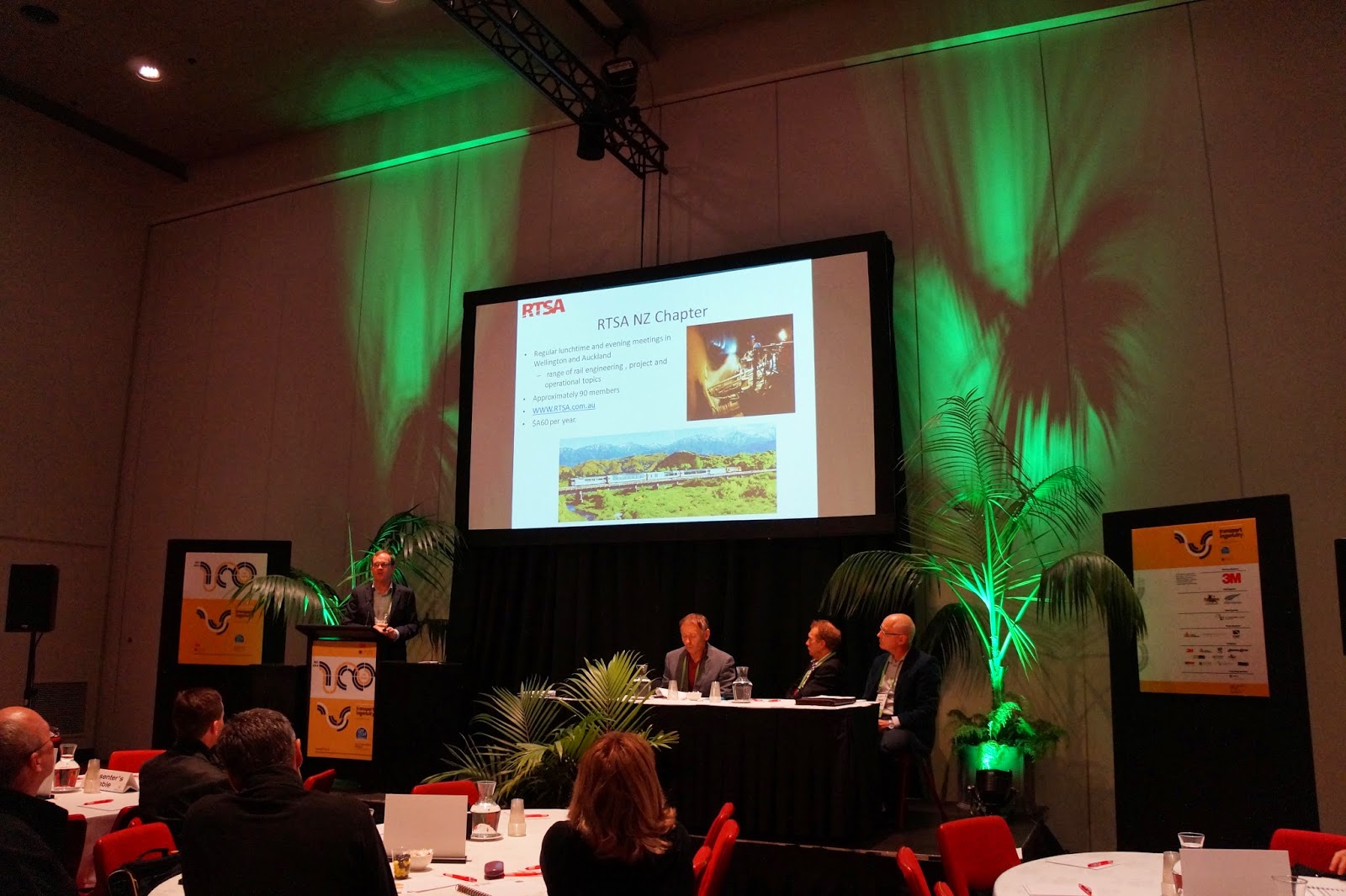
One of the morning streams was dedicated to the Railway Technical Society of Australasia a joint Technical Society of Engineers Australia and IPENZ New Zealand, formed to further the interests of the railway industry at large and its individual participants. With their upcoming conference CORE 2014 in Adelaide they are directed towards providing leadership for the facilitation and coordination of professionalism in the railway industry and the encouragement of member contributions to the application of railway technology and good management practices.


Michael McKeon from KiwiRai and then Randall Prestige from Target Railway Progress presented current and proposed New Zealand railway projects that will enable more efficient movement of freight and passengers across the country.


Overall the IPENZ Transportation Group 2014 conference was a great opportunity to learn about transport projects from the other side of Tasman sea. There are also  some good opportunities and ideas to enhance the collaboration between IPENZ and AITPM that are worth exploring the following days. I also found some good ideas that we can maybe adopt for our AITPM 2015 conference in Brisbane.

The quest for transport ingenuity is ongoing and more relevant now than ever in the history of 100 years of Engineers of New Zealand.

Sunday, 23 March 2014

AITPM@IPENZ Day 1

A few days ago, I had the pleasure and the honour to win the AITPM New Zealand Study Tour Award. This award gives the opportunity to an AITPM member to have the conference registration costs, reasonable travel & accommodation expenses to attend the conference and accommodation costs for an additional two days in the conference city fully paid by AITPM.

Wellington is a lovely city, relaxed but yet vibrant, with a very friendly atmosphere.

It kind of made me homesick as it reminded me a bit of Kavala. Harbour town build amphiteatrically around the water.

Wellington though, has some amazing museums with astonishing Maori art and artifacts.

The highlight of the CBD tour was the cable car ride. Wellington's cable car is more than 110 years old.

Networking with my New Zealand (and a few Australian) colleagues was fun with activities like the geocaching/ treasure hunt at Zealandia and a bridge building competition that proved that traffic engineers and transport planners are not only good in planning and designing bridges but also at building them.


This first day was very promising. I hope the rest of the IPENZ Transportation Group conference is as interesting and as fun.

Saturday, 18 January 2014

Moving around Sydney.

For the New Years Eve holiday period I took the family to Sydney on a city trip. I only had been to Sydney just once before on my trip to present the on-line mobility management toolbox at the AITPM conference in 2012. At that time I didn't had much chance to explore the city so this year I was keen to explore the traffic and transport in the city.

Moving around the city, I was quite impressed not only by the major attractions, the landmarks and the beaches but also with the extended public transport system. Although I was stunned to see and learn that the monorail was dismantled; buses, trains, light rail and most of all, the Sydney ferries all played a major role in discovering the city as a tourist.


In my previous time in the city I didn't have the chance to take a ride with the monorail system so I was quite disappointed when I found out that it no longer exists let alone operate. The funny side of the story was, that I was looking for it just outside the Haymarket station, looking at one of the maps at a light rail station. Apparently while the system was removed, the maps remain the same indicating the line and stations of the monorail system. I don't have the details of the removal project so I can't really say if that was a good or bad decision, but I must say that a lot of people would miss the monorail. Looking at the amount of pictures of the system in the Internet and sites like Panoramio it looks like it was a popular tourist attraction on it's own.


The Sydney ferries were my favourite transport mode in the city. The beautiful scenery along Sydney Harbour and Parramatta River and the views of the Sydney Opera House and Harbour Bridge are worth the slightly  more expensive ticket. Different but equally attractive is the night ride. I suggest to take the ferry to Manly so you can get a different view of the city.


Of course when considering moving around Sydney by public transport as a tourist, the best option is the one day MyMulti pass. With this ticket you can travel unlimited across the city for a full day (to midnight). Sydney Transport  has also a very good offer for Sundays called Family Funday Sunday where for $2.50 per person, your family gets unlimited travel on all trains, buses, ferries and light rail in Greater Sydney provided by a bunch of different operators. Another good choice for Sydney visitors is the free city CBD shuttle bus that runs every 10 minutes on a loop from Central Station to Circular Quay via George Street (both directions).

Sydney has a lot of common traffic and transport practices with Brisbane. But it also has a few differences that caught my attention. I have written in an old post about Dragon's teeth, the markings around school zones. Another interesting difference that I noticed was the footpath arrangement, where at least at the suburb where I was staying, was different than the usual Brisbane footpath. The concrete strip is located adjacent to the property boundary and not at the middle of the verge. Personally I like this arrangement and I think it allows for better landscaping with tall trees.


Sydney's inner suburbs have a unique character as they preserve to the most part their architectural heritage. Some of the traffic calming I saw also looked  quite old. They feel in line with that historical character as they are not the standard precast ones that lately have prevailed.


Of course not all traffic and transport parameters in Sydney were world class. Sydney's congestion is notorious and visiting the city at a holiday period helped me avoid all that. Another bad example of mobility management were the parking meters and the parking management system in general, outside the Botanic Gardens. Having to pay at a specific parking pay station for a number of bays can be quite confusing especially if you have parked at the outermost of the lot. In this area Brisbane's parking management system is a lot more advanced.


On the other side in Brisbane we don't have a parking facility like the Sydney Opera House underground parking. Although, that too has gone into receivership, it is a really beauty architecturally and a brilliant transport design. It's innovative double spiral design can accommodate approximately 1200 vehicles in 12 stories.

I can understand the frustration of everyday commuters facing delays on their trips to work or home. After all Sydney is an Alpha +  global city where traffic and transport improvements are a constant requirement. To me Sydney was a great trip experience and a great place to visit or live.

Sunday, 1 December 2013

Final destination: Changi airport.

I just came back from a leisure trip to Singapore and it was very interesting to notice a few things about air travel. Generally air travel is something that transport planners and traffic engineers are often professionally involved. Planning and designing airports, forecasting air passenger traffic and coming up with solutions for trips between terminals are some of the areas that a transport planner or a traffic engineer may provide his/her services. Over the last decade there were many changes in this field with most of the changes relating to  airports.


Airports are starting to become more significant than ever with some of them starting to become a destination of their own. This appears to be one of the top emerging travel trends. Air travel security checks and changes in airlines charging systems require passengers to be at the airport a long time before their flight. Long distance travel and airline alliances affect also the average time passengers spend as stopover between destinations. Competition between airports and the drive for alternative revenue has made airports reinvent themselves and change dramatically what they offer to passengers.

Changi International airport is probably the leading example, having won 430 awards since 1981, including 30 'Best' awards in 2012. The variety of services and experiences offered to passengers is beyond expectation. And the even more amazing thing is that the vast majority of them are free of charge. Depending on how long your stay in the airport is you can surf the Internet either from Internet stations or with Wi-Fi, visit and enjoy a number of different gardens that include a fantastic butterfly garden, get foot massage at Foot and Calf Massage stations, play a wide selection of Xbox and Playstation games, catch a movie at a movie theater or even get a 2hour Singapore Tour. And I repeat all of the above are offered free of charge.


Art and architecture is another field that airports are concentrating. Changi airport makes the list for the world's most beautiful airports. You can find amazing art pieces throughout the terminals with the Kinetic Rain installation catching the eye.


On top of these offerings the airport takes quality control and benchmarking very seriously, with numerous touch screens located in every spot of provided services for passengers to give their quality ratings.

Source
 The contrast with Darwin International airport which was my stopover on the way to Singapore was disappointing. There isn't really much to compare but the locked electricity wall sockets were the highlight of the terminal along with the almost torn apart sofas.


Choosing a flight in the near future, will become more and more affected by issues like stopover time but it seems that in certain occasions people will choose to ignore that in order to visit and experience airports as destinations. World airport competition is fierce and Australian airports although not centrally staged as Changi, need to keep up realising that the old philosophy of airport design is now obsolete.

Thursday, 23 May 2013

Freeway Of Love

Knew you'd be a vision in white
How'd you get your pants so tight?
Don't know what you're doin'
But you must be livin' right, yeah

We got some places to see
I brought all the maps with me
So jump in, it ain't no sin
Take a ride in my machine

City traffic's movin' way too slow
Drop the pedal and go, go, go

We goin' ridin' on the freeway of love
Wind's against our back
We goin' ridin' on the freeway of love
In my pink Cadillac

We goin' ridin' on the freeway of love
Wind's against our back
Ain't we ridin' on the freeway of love
In my pink Cadillac?

Never you mind the exit signs
We got lots of time
We can't quit till we get
To the other side

With the radio playin' our song
We keep rollin' on
Who knows how far a car can get
Before you think about slowin', slowin' down, yeah

City traffic's movin' way too slow
Drop the pedal and go, go
Come on now, go

We goin' ridin' on the freeway of love
Wind's against our back
We goin' ridin' on the freeway of love
In my pink Cadillac


We goin' ridin' on the freeway of love
Wind's against our back
Ain't we ridin' on the freeway of love
In my pink Cadillac?

Here we go, one more time

With the wind and your fingers in my hand
Kind of think we are going for an extended throw down
So drop the top, baby, and let's cruise on into
This better than ever street

City traffic movin' way too slow
Drop the pedal and go, go
Come on baby, go, do it for me now

We goin' ridin' on the freeway of love
Wind's against my back
We goin' ridin' on the freeway of love
In my pink Cadillac

We goin' ridin' on the freeway of love
Wind's against my back
Ain't we ridin' on the freeway of love
In my pink Cadillac


And what I want you to do, baby
Get over in the left lane
And let's merge with peace, oh, yeah
Take the love exit, and then make a right turn
Go on over to love and satisfaction and joy
Well, ain't we ridin' baby
Ain't we cruisin' down?
Free, free, free, freeway
Go on out to, ow
Let's be good to each other, scream
Freeway! Well
See that little landmark over there
A whole lot of kisses and sweet stuff
We'll be just about ow, ow, ow!
And satisfaction roll down
Satisfaction, yeah!

Aretha Franklin, song by Jeffrey Cohen & Narada Michael Walden

Saturday, 8 December 2012

Top Ten. Transport and Traffic Best photographs of 2012.

It's the time of the year that different top ten lists are published in an attempt to review this year that soon is coming to an end. Best songs, best movies, best shows and the lists go on. My favourite is lists of best photographs because as the Chinese proverb, quoted later (1911) by newspaper editor Arthur Brisbane say: "Use a picture. It's worth a thousand words." The web is filled with amazing photographs but I always give greater attention to the ones that involve transport and traffic. Browsing through such sites I realised that a significant percentage of these pictures involve transport and traffic on one way or another.

So here is my top ten list of the most spectacular transport and traffic photographs of 2012. I took the liberty to put my own titles on them as most of them were not published under the photographers original title. Apart from the title,  I list the country that the picture was taken, the photographers name and the news agency that published it. I kept the last spot in the list for one of my own photographs, because of it's special meaning. Is the photograph from the most popular blog post for 2012 and also is the photograph that reflects my pleasure for living and working in such a great city.


10. Bus rapid transit. Australia. KYRIAKOS TYROLOGOS.


9. Space Travel. USA, AFP

 8. Cruise Safety. Italy. PAUL HANNA. Reuters 

7. Highway Land Resume. China. CHINA DAILY. Reuters

 6. Alternative mobility. Colombia. FREDY BUILES. Reuters

5. Public Transport Overcrowd. Bangladesh.  ANDREW BIRAJ, Reuters 
thanks to fellow blogger Prafull for correcting me


4.Cost of fuel. Italy. ALESSANDRO BIANCHI. Reuters


 3. Freight Overload.Pakistan. MIAN KHURSHEED. Reuters

   2. School Active Travel.Indonesia. BEAWIHARTA. Reuters

  1. Storm Traffic Halt. United States. LUCAS JACKSON. Reuters

Saturday, 17 November 2012

Discussing countdown timers on Linkedin

Linkedin is a professional network on the Internet with more than 187 million members in over 200 countries and territories. It is like the Facebook of professionals. One interesting aspect of Linkedin is the groups which are a forum that some very interesting discussions take place. It is also a valuable source of information. I posted my previous blog entry on countdown timers at pedestrian traffic signals on Traffic Engineer and Transportation Planner Network group with a question whether this is an idea worth investing on or should we look for a totally different approach when it comes to pedestrian traffic in busy CBD intersections. I was very pleased to see that this topic sparkled a very interesting conversation. Traffic and transport professionals from around the world posted their comments on the issue. Some of them shared links to study reports on countdown timers’ trials on different countries. The majority of the responses were in favour of installing such devices on traffic lights. Here are some of the comments:

Ray Guarino, Transportation Planner at Old Colony Planning Council, Brockton, Massachusetts: “Yes, they are worth the investment. In busy urban areas these countdown timers work great. If you want to see them in action at busy intersections, and you are the USA, go to the corner of Boylston and Tremont in Boston, Massachusetts.
                                                                                                                
Jim Lizzi, Senior Transportation Engineer at City of Irvine, Orange County, California: “I support the use of countdown timers simply because the information transmitted to pedestrians is of value.” and “With countdown timers, at least pedestrians know for sure when they should definitely NOT start crossing. The bottom line for me is that safety--of all kinds--is enhanced through understanding.”

Jakob Helmboldt, Pedestrian, Bicycle & Trails Coordinator at City of Richmond, Virginia: “In the US countdowns will soon be mandatory (end of 2013 is the current compliance date). Countdowns do have benefits, and FHWA wouldn't be requiring their use if the experimental use showed significant impaired safety. More information is always better than less when it can be conveyed with ease which is the case with a countdown signal. That said, there are always negative externalities possible, but on balance they are an improvement.”

Jeff McMullen, Chief Engineering Technician ITS/TOC at City of Fresno, California: “I agree that the countdown timers are great for pedestrians however, although I have no data to back this up other than observation, motorists are using the countdown timers also. When they see that the time is about to expire they (the aggressive drivers) tend to speed up to ensure they can make it through the signal.”  

Chuck Weaver, Senior Designer at Brudis & Associates, Baltimore, Maryland: “I've been designing intersection in MD for years....we are upgrading to APS/CPS almost everywhere”

Tony Earl, Head of Network Performance at Transport for London, Redhill, United Kingdom: “I am currently rolling out Pedestrian Countdown at Traffic Signals (PCaTS) to 200 signals with all red to traffic Pedestrian Stages in London following a study undertaken on behalf of Transport for London by TRL. This is now approved for use in the whole of England. You may find the study report of interest.”

Martin Huang, Traffic Engineer at Tauranga City Council, New Zealand: “We have also installed some countdown timers at one of our signalised intersections in our city. From my observations and previous research undertaken in New Zealand, it appears that the benefits from the device are more qualitative than quantitative. About 90% of the interviewees are positive about the installation while only several percentages of crash and compliance rate have changed. To me personally, I see it as enabling to provide clear messages for pedestrians to make an informed decision. Teenagers can dash across the road with less than 10 seconds but the elderly would be safely to wait for next cycle even if it is 15+ seconds left.” and “Just for your information, there are 2 research reports about trials of countdown timers application in Auckland and Wellington and their links are shown below.
http://www.nzta.govt.nz/resources/research/reports/428/
http://www.ipenz.org.nz/ipenztg/papers/2007/C4a_HooperVencatTse.pdf

Pravin Dayaram, Director at Traffic and Transportation Engineers Ltd, New Zealand: “n Auckland, the countdown timers seem to have been implemented only at (or in conjunction with the change to) what we term locally as 'Barnes Dances' (all traffic stopped pedestrian movements cross at the same time and named after the developer). My observations indicate that there is significantly less non-compliance (crossing during the short flashing-red man phase)…”
 District Department of Transportation Columbia

Glenn Cole, Manager, Technical Information Programs at Transportation Association of Canada, Ottawa, Canada: “The Transportation Association of Canada (Traffic Operation and Management Standing Committee) put together a small study: Informational Report on Pedestrian Countdown Signals. It's available on line at
http://wiki.tac-atc.ca/twiki/pub/ChiefEngineers/PedestrianCountdown/Project_253_-_Optional_Use_of_Pedestrian_Countdown_Timers.PDF

The story Rob Klug, Traffic Signal Engineer at Clark County Public Works Portland, Oregon shared with the group was very interesting: “My favorite citizen interaction was with an elderly person who approached me at an intersection we just installed the countdown timers at, where I was working on the cabinet. She told me that she really appreciated all the extra time that she was given by these new countdown heads. She never got across the street within the flashing don't walk, but all the extra time we gave her with the new heads made it so that she could get across the street with 4 or 5 seconds to spare. I explained that we did not change any settings on the control equipment, but she was probably adjusting her walk speed based on the time she saw was left on the countdown.  She crossed her arms, and said in a very stern voice "I know you changed the timing. I never was able to cross within the time, now I can". I told her the only thing that made sense. "You are welcome", and went back to work.”

Image from 7 News video
We are living in a new era of professional and scientific communication and dialogue. The duty of mobility practitioners is to make an effort to be part of this new world, use the available means in a responsible way and share knowledge and experience.

Saturday, 28 July 2012

Olympic Games traffic


I am watching the Olympic Games 2012  opening ceremony and as always my mind goes to transport and traffic. 


The Games being such a huge event, involving thousands of participating athletes, coaches and spectators are such a great challenge for the transportation planners and traffic engineers of each hosting city. 


Even in the hosting city selection procedure, transport and traffic is the second most important aspect of the candidate cities’ proposal after venues. Cities are struggling to persuade the “immortals” that they can manage traffic during the Olympic games in a way that not only will be effective but also sustainable. The games provide the opportunity for the cities to build new transportation system like the Athens Metro and tram. 


But even big transport infrastructure projects like public transportation systems and construction of new motorways and arterials are not enough to ensure that athletes would not need two or three hours of travel to get to their Olympic venue. Transport planning, traffic management and mobility management plays a big role in this task. After all, transportation network capacity is not designed to support all this additional demand for travel. 

One of the traffic management measures used, is sending a significant percentage of the Olympic city’s residents away from the city or having them stay at home. Usually this is achieved by giving civil servants mandatory leave and generally by making it so much more difficult for people to travel to their usual every day destination, so they will prefer to go on holidays or stay home. Again Athens was an example for this with so many Athenians spending their days during the Olympic Games in the islands.

The objective is to enable athletes and officials to get to their events on time. This is accomplished by installing Olympic lanes. Roads or traffic lanes reserved for accredited Games vehicles – athletes, officials and of course sponsors – as well as emergency vehicles. In London there are 30 miles of Olympic Lanes installed mainly on some of the city’s main arterial roads, marked by white Olympic rings painted on to the road. 


No one else is allowed in these lanes, not even black taxis or bicycles and this raises discomfort, protests and even extreme police actions that don't exactly promote the Olympic spirit.  

Trying to achieve optimum traffic management is not an easy task as some of London’s biggest traffic engineering gaffes show. 


Olympic Games have blown out of proportion during the last decades thanks to the commercialization spirit. The sponsors and the often greedy national Olympic committees push to include more sports and more athletes to the Olympic Games and finally cities that host the games do not benefit from them overall.At least it seems that they benefit from some improvement to their transport systems and the added experience in mobility management.