Last day of the conference and I am happy to report on the conference proceedings back from Brisbane. I fully enjoyed my stay in Wellington but... give me Brisbane any day.
The conference day kicked of with keynote speaker Steven Newman, CEO of EROAD. I was hoping that Steven will speak about the work he did on road charging but Steven preferred to speak about future transport systems or as he called it super intelligent transport systems.
The second keynote speaker for the day was Rob Merrifield. Rob has worked for more than 50 years on road construction and management but his passion was always studying the historic development of transportation. From the Diolkos and the other ancient Greek rutways to the 1834 Newcastle upon Tyne railway and other tramway systems in England it seems that archeology takes more and more interest in transport systems of the past.
One of the morning streams was dedicated to the Railway Technical Society of Australasia a joint Technical Society of Engineers Australia and IPENZ New Zealand, formed to further the interests of the railway industry at large and its individual participants. With their upcoming conference CORE 2014 in Adelaide they are directed towards providing leadership for the facilitation and coordination of professionalism in the railway industry and the encouragement of member contributions to the application of railway technology and good management practices.
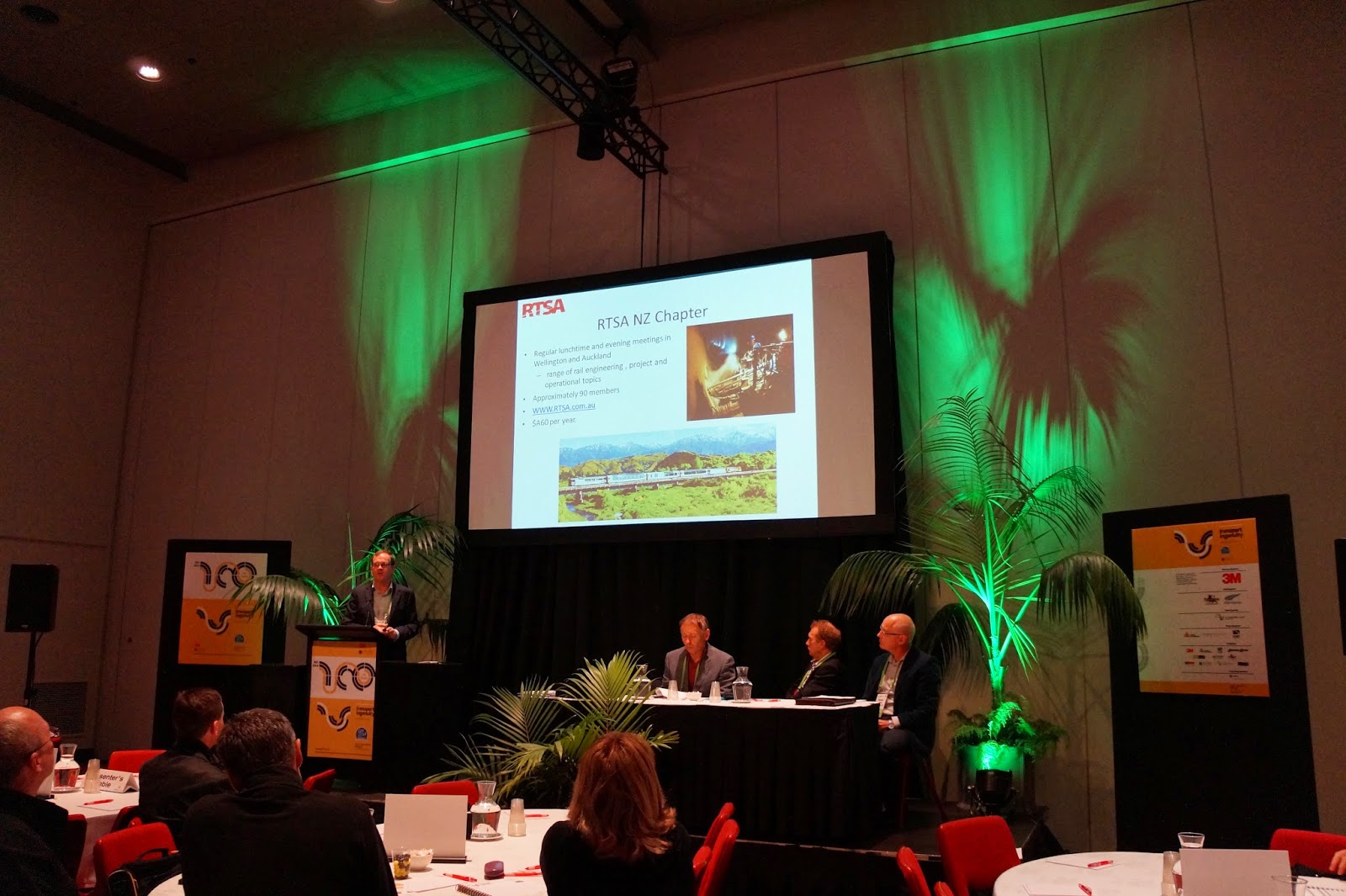
Michael McKeon from KiwiRai and then Randall Prestige from Target Railway Progress presented current and proposed New Zealand railway projects that will enable more efficient movement of freight and passengers across the country.
Overall the IPENZ Transportation Group 2014 conference was a great opportunity to learn about transport projects from the other side of Tasman sea. There are also some good opportunities and ideas to enhance the collaboration between IPENZ and AITPM that are worth exploring the following days. I also found some good ideas that we can maybe adopt for our AITPM 2015 conference in Brisbane.
The quest for transport ingenuity is ongoing and more relevant now than ever in the history of 100 years of Engineers of New Zealand.
My view on Mobility Management theory, principles, strategies, ideas and best practices. From the experience gained in Europe to the every day life in Australia. How can mobility management make our life in the cities better?
Showing posts with label transportation. Show all posts
Wednesday, 26 March 2014
AITPM@IPENZ - Last day. Ingenuity now more than ever.
Labels:
AITPM,
Brisbane,
conference,
Diolkos,
EROAD,
freight,
IPENZ,
KiwiRail,
New Zealand,
traffic,
transport,
transportation,
Wellington
Location:
Brisbane, QLD, Australia
Saturday, 28 July 2012
Olympic Games traffic
I am watching the Olympic Games 2012 opening ceremony and as always my
mind goes to transport and traffic.
The Games being such a huge event,
involving thousands of participating athletes, coaches and spectators are such
a great challenge for the transportation planners and traffic engineers of each hosting city.
Even in the hosting city selection procedure, transport and traffic is the second most important aspect of the candidate cities’ proposal after
venues. Cities are struggling to persuade the “immortals” that they can manage
traffic during the Olympic games in a way that not only will be effective but
also sustainable. The games provide the opportunity for the cities to build new
transportation system like the Athens Metro and tram.
But even big transport infrastructure projects like public
transportation systems and construction of new motorways and arterials are not
enough to ensure that athletes would not need two or three hours of travel to
get to their Olympic venue. Transport planning, traffic management and mobility management plays a
big role in this task. After all, transportation network capacity is not designed
to support all this additional demand for travel.
One of the traffic management measures used, is sending a significant
percentage of the Olympic city’s residents away from the city or having them
stay at home. Usually this is achieved by giving civil servants mandatory leave
and generally by making it so much more difficult for people to travel to their usual
every day destination, so they will prefer to go on holidays or stay home. Again
Athens was an example for this with so many Athenians spending their
days during the Olympic Games in the islands.
The objective is to enable athletes and officials to get to their events on time. This is accomplished by installing Olympic lanes. Roads or traffic lanes
reserved for accredited Games vehicles – athletes, officials and of course sponsors
– as well as emergency vehicles. In London there are 30
miles of Olympic Lanes installed mainly on some of the city’s main arterial
roads, marked by white Olympic rings painted on to the road.
No one else is
allowed in these lanes, not even black taxis or bicycles and this raises discomfort, protests and even extreme police actions that don't exactly promote the Olympic spirit.
Trying to achieve optimum traffic management is not an easy task as
some of London’s biggest traffic engineering gaffes show.
Olympic Games have blown out of proportion during the last decades
thanks to the commercialization spirit. The sponsors and the often greedy
national Olympic committees push to include more sports and more athletes to
the Olympic Games and finally cities that host the games do not benefit from
them overall.At least it seems that they benefit from some improvement to their transport systems and the added experience in mobility management.
Labels:
2012,
bicycle,
candidate city,
London,
mobility,
mobility management,
Olympiad,
Olympic games,
Olympic lanes,
sustainable mobility,
sustainable transport,
taxi,
traffic,
traffic engineering,
transportation
Location:
Brisbane, QLD, Australia
Saturday, 30 June 2012
BRT or LRT? Busway or Light Rail?
Few days
ago I went back to the Gold Coast for a technical seminar on the new Light Rail Project that is now under construction there. The stage one of the project will
cost $ 1 billion to deliver a 13 km route between the Gold Coast University Hospital and Broadbeach. This new public transportation system will commence operations
in 2014 well ahead of the Commonwealth Games that Gold Coast will host in 2018.
The system in this first stage will consist of 14 trams and 16 stations and it
is expected to move 50,000 passengers a day with a capacity to cater for up to
75,000 passengers a day.
The trams
are constructed by Bombardier and are 43.5 metres long, 2.65 metres wide and
can travel at speeds up to 70 km/h. The trams are the latest generation of
FLEXITY 2 Light Rail Vehicles that are used in Croydon and Docklands in London, Nottingham and Manchester, Blackpool and Lancashire. The unique feature for the Gold
Coast trams will be of course the Surfboard racks.
This new system
will be the first light rail system in Queensland. Previous attempts to propose
planning and construction of such a system in Queensland’s capital city Brisbane were unsuccessful. Public spending
in transportation is directed to the bus system like the CityGlider and CityCats.
In the traffic engineering – transportation planning community there is a big and long standing debate on the benefits of light rail systems against bus rapid transit systems. The BRT or busway as they are called in Australia is at the moment the preferred choice in Brisbane. Personally I am not sure that there is a clearly superior system between the two. Probably it depends on the urban environment and the characteristics that those systems are to be designed and operate. And while busways are usually less expensive to implement and more flexible and adaptive to changes, the light rail systems give the city a world class image lift and support residential and commercial development along its stations.
After all, the way busways work in Brisbane, some times they give the impression that we do have a light rail.
Labels:
Australia,
Bombardier,
Brisbane,
Broadbeach,
BRT,
busway,
CityGlider,
commuters,
Gold Coast,
light rail,
LRT,
rail,
rapid transit,
sustainable mobility,
sustainable transport,
traffic,
train,
transportation
Location:
Brisbane, QLD, Australia
Sunday, 19 February 2012
Commuting from Gold Coast to Brisbane - Part 2. What people do?
My last post was
about my impressions of commuting by train from Gold Coast to Brisbane. It is
indeed very slow and uncomfortable and that is why the majority of people do
not use it. But there is a big number of people living in the Gold Coast and
working in Brisbane and a not so big but still significant number of people
commuting the other way. So what all these people do every day?
Well I suppose
for the people living in Brisbane and working in Gold Coast is fairly easy. They drive each day
through the M1 Motorway and find a relatively easy and cheap parking spot in
Gold Coast.
But how about people
from Gold Coast working in Brisbane? Here is what they do:
First option: They
drive to Brisbane but not to the CBD because of the very expensive parking. Instead
they drive just outside the limits of the traffic control areas and try to find
a free on street parking space.
The most popular
areas for this are: Lower West End and Highgate Hill, Buranda, Stones Corner, Norman Park, Coorparoo.
Second option: They drive to one of the many park and ride spaces that Citytrain provides in
the suburbs and then take the train. Popular Southeast stations for park’n’ride:
Fairfeild,
Yeronga, Yeerongpilly, Moorooka and some Northeast stations like Buranda, Coorparoo and Norman Park.
Third option:
They drive to different inner suburbs and then park illegally wherever they
think they have better chances of not getting fined.
Of course there
are quite a few other options that people follow in order to move from their
place of living to the place of work.
But of course
all these options are not viable sustainable transportation. They create lots
of troubles to people on those Brisbane suburbs and at the end of the day they don’t save that much time
and money for commuters.
Saturday, 11 February 2012
Commuting by train Gold Coast to Brisbane. Captain Slow is on the driver’s seat
Having to
commute every day from Gold Coast to Brisbane I experience first hand the
good and the bad of commuting by train. First let me give you some useful data:
The distance
from Surfers Paradise to Brisbane CBD is around 77 kilometres and driving
through the M1 motorway or as they call it Pacific motorway will take you less
than an hour. That is even in peek hours but not when you run onto a road
accident that is quite common in M1 motorway which is very heavy on traffic
and is considered one of the most dangerous highways in Australia regarding accidents. In those cases total travel time might be as long as two
and a half hours. Plus if you go by car in
Brisbane city centre then you have to pay a small fortune every month for parking.
So this is a
great opportunity to develop the sustainable and environmental friendly
solution of train commuting. But unfortunately train is not that popular in South East Queensland. And if this is not the case for the people living here,
it certainly is the case for the decision makers. And let me explain this:
The rail line that connects Gold Coast (in general and not Surfers Paradise) with Brisbane
City Centre is almost 90 kilometres long making a journey from Surfers Paradise
to Brisbane a total of one hour and a half.
That is about 20 minutes by car to
Nerang Station -where fortunately there is a free commuter parking- and then 70 minutes from there to Central Station in Brisbane. If we
consider the rail distance from Nerang Station to Brisbane Central Station is 75,9
kilometres, that makes the average train speed 65 kilometres per hour. Did you
say slow? Actually it is slow, regarding all train standards and not just highspeed rail.
"Ok I can not sleep but can I use this time to
work in my laptop?" Bad luck again. No tables at all and not enough space to
have it even on your lap.
"How about wireless internet connection?" Only a small number
of the trains have that and not in every car. And when
you are lucky enough to be in one of those then there is a time limit and a limit
in what you can access. So, no youtube videos or other streaming media.
But even you are
someone that does not care for all this and you just enjoy reading a good book
during trip time then you should take care where you board the train. Almost all
trains during the peak hours run full so for the
most part of the trip there are a lot of standing passengers. Add to that that
the trip frequency is not good having only 3 trains from Gold Coast between 7-8
am and only 5 trains between 7-9 am.
In one of my
next posts I will write about what people commuting from Gold Coast to Brisbane do and
what they can do with a little help from state government and the two city
councils.
Labels:
Australia,
behaviour change,
Brisbane,
commuters,
Gold Coast,
mobility,
motorway,
rail,
railway,
road safety,
sustainable mobility,
traffic,
train,
transportation
Location:
Surfers Paradise, QLD, Australia
Sunday, 11 December 2011
Shared Bikes – Way to go Brisbane
Brisbane is the one of two Australian cities
with a bike sharing scheme. It is the newest in Australia and the biggest regarding the total
number of bikes with 1000 operating and 1000 more soon to be offered. The
bicycles in CityCycle look a lot like those of Velib in Paris where the bike sharing scheme is a huge
success with more than 20000 bikes on Parisian roads. CityCycle bikes can be
found in 104 (soon to become 150) stations in the city centre and the
surrounding neighbourhoods. In order to use CityCycle you need to subscribe and
then you can ride for free for a period of 30 minutes. As long as the bikes are returned to
a station within half-hour intervals the user can ride all day for free. If
there is a need for longer usage then there are usage fees.
Bike sharing is a great idea for the cities
aiming at providing an alternative to private car use in the city centre,
thereby reducing traffic congestion, noise, and air pollution. It is a great
practice for cities with parking supply problems. It also aims at supporting
the use of public transportation and especially for commuters as it provides
the means to the last part of the home to work trip. Besides the obvious advantages of moving by
bike like benefits in health and cleaner urban environment, bike sharing
schemes are great for tourists as they provide an easy way to visit more city
attractions and reach more city businesses.
There is some criticism about CityCycle
especially regarding that is not so successful in attracting users. Major
reasons for this are the initially high daily subscription which was 11 $ and
the mandatory helmet use. The first issue was recently addressed by setting the
daily subscription to 2$ which had an instant effect on rising casual hires.
But the mandatory use of helmet is not. Australian bike sharing schemes are the
only known bicycle share schemes that operate under a mandatory helmet
requirement. But who would carry with him a helmet at all times just to use it
on his last part of the daily trip to work? Also who will carry a helmet on the
chance that he/she might want to borrow a bike for a quick trip to run an
errand? Netherlands and Denmark are the countries with the highest
percentage of bicycle use and very low percentage of accidents and no mandatory
helmet use. Maybe we can learn from the best.
Labels:
Australia,
behaviour change,
bicycle,
bike,
Brisbane,
CityCycle,
Gold Coast,
health,
helmet,
mandatory,
mobility management,
parking,
shared,
sustainable mobility,
sustainable transport,
traffic,
transportation,
Velib
Location:
Surfers Paradise QLD, Australia
Friday, 2 December 2011
Shared Space – Streets for everyone
By the term “Shared
space” we define the design approach that seeks to change the way streets
operate by reducing the dominance of motor vehicles, primarily through lower
speeds and encouraging drivers to behave more accommodatingly towards pedestrians.
In addition the use of level surface tends to remove a physical and
psychological barrier to pedestrian movement. It can also indicate to drivers
that pedestrians are not confined to the footway and that they can expect to
encounter them in the whole of the street.
The other basic measure in shared space is reducing demarcation. Removing almost every road sign like speed limits and traffic lights increases the amount of interaction taking place between pedestrians and car drivers. Reducing demarcation indicates that the street is meant to be shared equally by all users of the street. Implied priority for vehicles is reduced, as are physical and psychological barriers to pedestrians using the street.
Shared space is not
a solution for every city street. But is a great solution for streets with high
leisure activity, historical importance and small commercial shops. Shared
space enhances a street’s sense of place. As it is an idea based on
sustainability all the basic principles of sustainable mobility must be
considered. Successful shared space streets do not have to use costly
materials, and their maintenance requirements are low.
Such proposals can
benefit especially tourist destination cities. All that is needed some open
minds and some political support.
Labels:
Australia,
equity,
Gold Coast,
health,
mobility management,
Shared space,
soft measures,
sustainable mobility,
traffic,
transportation
Location:
Surfers Paradise QLD 4217, Australia
Wednesday, 16 November 2011
Car2Go anyone?
Cost is 24 cents per minute including fuel, service, taxes, insurance, maintenance etc. Moreover, for one hour a maximum price of 12,90 euros applies. All of that without security deposit and monthly fee. Only a one-time registration fee of 19,00 euros becomes due and will be charged to your banking account.
In Ulm and Neu Ulm they instantly loved it. Daimler realised they had something that can make a difference. Many European and American cities inquired about the project. So now the same car2go car sharing scheme works in Vancouver, Austin and San Diego in America and Hambourg, Amsterdam, Wien and Lyon in Europe. In San Diego Daimler is trying emission-free electric vehicles.
I dont know if this advanced car sharing scheme is "The first personal public transport" as Car2Go website claims but surely is a thing that we will be viewing more and more in the years to come.
Any Australian cities interested?
Tuesday, 15 November 2011
Welcome to mobility management Australia
I want to welcome you all to Mobility Management Australia blog.
In this blog I will try to inform you on issues of mobility management and the way they can provide solutions to traffic and transportation problems in Australian cities. This is a blog for everyone and not just traffic and transportation engineers and planners. So I will try to make it as simple as possible and avoid using "heavy" scientific terms.
There will be information on what is Mobility Management and what is sustainable mobility. There will be also information on practical solutions adopted by Australian and European cities that helped them tackle traffic problems. There will be also interesting mobility and urban practices and article links.
The rest you will see them in time.
Hope you enjoy
Kyriakos Tyrologos
Traffic, Transportation and Urban Planner
Gold Coast
QLD
In this blog I will try to inform you on issues of mobility management and the way they can provide solutions to traffic and transportation problems in Australian cities. This is a blog for everyone and not just traffic and transportation engineers and planners. So I will try to make it as simple as possible and avoid using "heavy" scientific terms.
There will be information on what is Mobility Management and what is sustainable mobility. There will be also information on practical solutions adopted by Australian and European cities that helped them tackle traffic problems. There will be also interesting mobility and urban practices and article links.
The rest you will see them in time.
Hope you enjoy
Kyriakos Tyrologos
Traffic, Transportation and Urban Planner
Gold Coast
QLD
Subscribe to:
Posts (Atom)


