I still hang around...
Neither lost, nor found.
Hear the lonely sound,
of music in the night,
Nights are always bright...
Thats all thats left for me..
I play the street life,
Because there's no place I can go
Street life, And it's the only life I know
Street life, And there's a thousand parts to play
Street life, Until you play your life away
You let the people see
Just who you want to be
And every night you shine
just like a super star
That's how the life is played
A ten cent Masquerade
You dress, and walk, and talk
you're who you think you are...
Street life, You can run away from time
Street life, For a nickel, or a dime
Street life, But you better not get old
Street life, Or you're gonna feel the cold
There's always love for sale
A grown-up fairy tale
Prince charming always smiles
behind a silver spoon
And if you keep it young
Your song is always sung
Your love will pay your way
beneath the silver moon
Street life. Street life. Street life. Street life...
The Crusaders and Randy Crawford
(1979-Will Jennings, Joe Sample)

Showing posts with label culture. Show all posts
Showing posts with label culture. Show all posts
Saturday, 26 January 2013

Wednesday, 26 September 2012
Car free day
Last Saturday, 22 September 2012 was the world car-free day. People, communities, cities and countries from around the world organise events to celebrate and promote sustainable mobility.


 |
| Gratz, Austria |
While the idea of restricting car access to specific streets or parts of the city even for just a few hours of a single day per year is pretty old, it was back at 1994 that a formal world day started to be organised. In 2000 the European Commission adopted the idea and funded the whole project under the title “In town without my car”. The campaign was a huge success not only in Europe but also in other countries. Since 2002 cities in Europe celebrate the “European Mobility Week” an annual event in September around the "In town without my car!" day. By 2008 more than 2100 local governments from 39 countries participated either in the single day celebration or the whole mobility week.
The first Australian Car Free Day was held in the City of Fremantle on 29 November 2000. Fremantle tried again on 2001 and 2002 organising the “Shed your car day”. Other cities in Australia tried to organise similar events but without coordination amongst them and not much success.

Pedestrians, bicycles, public transit and other forms of sustainable transportation are encouraged on these days. People have tolerated too long congestion, air pollution and all other side effects of car traffic in the cities.

As the theme and logo of this year’s European Mobility Week says “Do the right mix”.

At the same time that neoliberal policies and austerity measures deepen the economic crisis in Europe,

extending it into a social crisis, there are still a few lessons that we can learn from their practices towards a new culture in urban mobility.
Tuesday, 29 May 2012
Pasadeiras
Just found a nice piece of traffic artwork by a Portuguese advertising agency Draft FCB Lisbon.
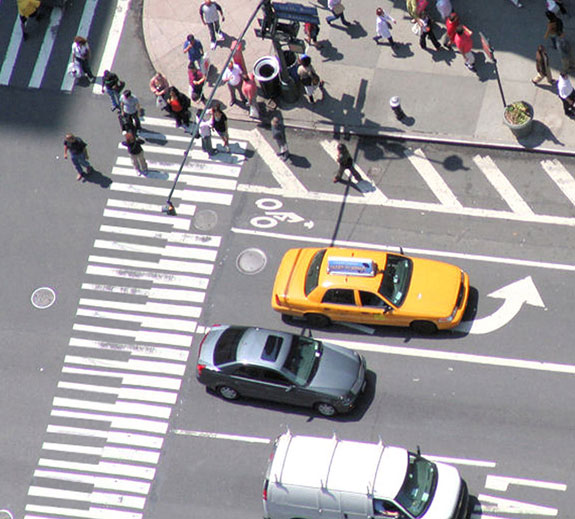
It is pedestrian (zebra) crossing painted in a street in Lisbon, Portugal as part of a "safe street week" campaign in cooperation with The Association of Self-Mobilized Citizens ACA-M.
The pedestrian crossing stripes consisted of names of pedestrians killed by cars.
In both ends of the crossing is is written that 1/4 of all victims in car accidents are pedestrians.
I am sure that a lot of questions are raised regarding the actual safety of this pedestrian crossing as people may stop in the middle of the road to read the names but reports from Portugal say that no accident happened there since it was installed.
And this zebra crossing is not the only piece of pedestrian crossing artwork. Everyone knows the famous zebra crossing on Abbey Road, London that made the cover of The Beatles Abbey Road album.
 Abbey Road studios that was the place that The Beatles recorded that album has now a web camera pointed on that crossing. Check it out to see tourists reproducing the famous cover photo.
Other famous crossings that can be found around the world and around Internet:
 Salzburg, Austria.
 South Africa.
 Qujiang District, Xi'an, China
 Canada.
It is pedestrian (zebra) crossing painted in a street in Lisbon, Portugal as part of a "safe street week" campaign in cooperation with The Association of Self-Mobilized Citizens ACA-M.
 | |
| Source: http://cargocollective.com/filipegraca/Passadeiras-ACAM |
The pedestrian crossing stripes consisted of names of pedestrians killed by cars.
 |
| Source: http://cargocollective.com/filipegraca/Passadeiras-ACAM |
In both ends of the crossing is is written that 1/4 of all victims in car accidents are pedestrians.
I am sure that a lot of questions are raised regarding the actual safety of this pedestrian crossing as people may stop in the middle of the road to read the names but reports from Portugal say that no accident happened there since it was installed.
And this zebra crossing is not the only piece of pedestrian crossing artwork. Everyone knows the famous zebra crossing on Abbey Road, London that made the cover of The Beatles Abbey Road album.

Other famous crossings that can be found around the world and around Internet:


Sunday, 22 April 2012
April Fools’ Day traffic.
Although
this is not one of my favourite days of the year I must admit that I found
rather funny and amusing the following stories with urban traffic themes.
The first one comes from Philadelphia USA. Watch the Mayor announcing the E-lane initiative where pedestrians can
walk and use their mobile at the same time safely.
The second one comes from Vancouver Canada where Vancouver Observer online newspaper announces the province's new mandatory pedestrian helmet law. This one if it was on Brisbane Times it would be more believable since Australia has already the mandatory cyclist law.
The
first really interesting April fools’ day story about traffic and
transportation that made world headlines was the Copenhagen’s new subway. It looked as
if one of its cars had an accident, and had broken through and surfaced on the
square in front of the town hall.

April Fools ’ Day presents a great opportunity to draw peoples attention
to sustainable mobility and humour is quite an effective way to reach
behavioural change.
Monday, 21 November 2011
Principles of Sustainable Mobility
Sustainable mobility or
sustainable transport is the basic theory behind mobility management.
But what is sustainable mobility? There are many definitions available in bibliography. My personal favourite is the one from World Business Council for Sustainable Development that in 2001 defined sustainable mobility “as the ability to meet the needs of society to move freely, gain access, communicate, trade, establish relationships without sacrificing other essential human or ecological values, today or in the future”.
 So the basic principles
behind sustainable mobility and mobility management are:
So the basic principles
behind sustainable mobility and mobility management are:
But what is sustainable mobility? There are many definitions available in bibliography. My personal favourite is the one from World Business Council for Sustainable Development that in 2001 defined sustainable mobility “as the ability to meet the needs of society to move freely, gain access, communicate, trade, establish relationships without sacrificing other essential human or ecological values, today or in the future”.


EQUITY Inter and Intra generation
Mobility that
- fulfill the rights of every person regardless of age, gender, ethnicity, social and economic status.
- meets the needs of the present without compromising the ability of future generations to meet their own needs.
HEALTH for people and environment
Mobility that
- supports complete physical, mental and social wellbeing and not merely the absence of disease and infirmity.
- provides options for people while remaining within the carrying capacity of the local, regional and global environments.
PROGRESS Satisfy people needs,
provisioning, prosperity, joy
Mobility that
- aims in satisfying people needs for transportation, reducing transportation cost, preparing and equipping infrastructure networks.
- reduces people tension, anxiety and anger while enhances their prosperity and joy.
EMPOWERMENT participation, options
Mobility that
- increases the spiritual, political, social, or economic strength of individuals and communities.
- encourages people active participation and aims at providing people with more options.
CULTURE diversity, individuality, joy
Mobility that
- respects cultural diversity and encourages cultural production.
- enhances individuality and works towards happier local communities.
Subscribe to:
Posts (Atom)