Monday, 23 June 2014

World cup in Brazil. Stadiums instead of public transport.

I am a huge fan of football or soccer as it is called in the English speaking world. Unfortunately Brazil is a long way from Brisbane and as much as I would love to be able to watch Greece or Australia play at the world cup, unfortunately I had to watch the games on TV.


The Mundial as I've learned to know the world cup from my youth, as all huge sport competitions has also a transport and traffic side. As in the London Olympic games in 2012, the organizers have to plan an effective way to move tens of thousands of people to and from the venues safely. The big difference of the world cup from the Olympic games, is that the world cup is hosted across a whole country and there is only one game at a time while the Olympic games are hosted around a city (and a bit further out) with lots of different games and sports happening at the same time. The Olympic games are much bigger competition from a transport and traffic point of view but the transport task of the Mundial is quite significant as well.

Brazil promised FIFA and the Brazilian people a series of upgrades on it's infrastructure. And while FIFA, which is accused for corruption cared more about the new stadiums like the new Sao Paolo arena, the carrot for most Brazilians was the upgrades to transport infrastructure. A series of transport projects like upgrades to airports and new light rail systems were planned to be delivered supposedly just before the first whistle of the referee in the game of Brazil against Croatia.

In reality Brazil ended up spending a huge amount of money and failed to deliver a lot of the transport infrastructure upgrades that it promised. The light rail in Cuiaba where Australia played the first game against Chile, was meant to help soccer fans get around but was not ready in time. Instead, the new light rail line from the airport into the city runs for just 500 metres until it disappears completely.
And there are a lot of other traffic and transport related issues that add to Brazilians' disappointment and frustration.

Traffic congestion and gridlocks around stadiums is a regular phenomenon and that caused a number of fans to miss the opening minutes of matches. Even the second best football player of all times, missed the first half of the opening game between Brazil and Croatia, held up in traffic.

Fans in Brazil, also experience big delays at airports, as the network capacity can not cope with all the demand and a lot of the airport upgrades were not delivered in time. And then there are those unlucky fans that were delayed in air traffic just because elected politicians want to demonstrate their country's superiority through sports.

All these traffic problems, along with massive hikes in public transport fares and extreme poverty led to protests, especially on the transport sector and clashes with the police.

Next time we take a break at the game's half-time, let us take a moment and ask a simple question like the kid on the photograph. If people don't even benefit from the infrastructure upgrades of such sport events, then what's really left?


Wednesday, 28 May 2014

Flying around Australia

Lately I've been busy with meetings around Australia and that meant I would have again the opportunity to observe transport systems around air travel.

My flight to Rockhampton was very early in the morning so I had to catch a taxi to Brisbane airport. I called the taxi company on the phone that I've found on the net and a few minutes later there was a Toyota Prius taxi waiting for me outside my house. The drive was a breeze as it was pre peak hour and the taxi driver asked me if I wanted to go via the tunnels which I decline due to tolls and low traffic.

Rockhampton airport is not big but it is well organised and modern. Rental cars are located just in front of the entrance to the terminal. Your other options are either taxi or a bus service to the city.

Rocky, as the locals and other Queenslanders call Rockhampton, is the beef capital of Australia. Beef is celebrated everywhere with numerous bull statuses around the city.


A few days later, I had to fly to Melbourne. This time, the flight was in the afternoon so I had some time to catch the Airtrain rather than a taxi, as they can be very expensive. For a cost of around $15 you arrive 20 minutes later at Brisbane Airport. The train service is of a high level with the only problem that it stops at 22:00 and leave the late night flights without coverage.

In Melbourne for around the same money and the same travel time you get to go to from Melbourne Airport to your hotel in Melbourne CBD by buses.  Skybus is an outstanding bus service that not only connects Tullamarine Airport to the CBD but also delivers you to your hotel door (or close) for the same price that takes the rest of the passengers just to Kings Cross station.


I was quite surprised when I arrived at Kings Cross station, as the lady that sold me the return ticket at the airport booth didn't say anything for the hotel part of the trip. I felt like I was at an asian capital. A number of small buses like the one in the picture above and drivers hanging outside the ticket office. I guess we do learn some things from our asian neighbours. The best part is that even on the return trip you can arrange to be collected outside your hotel in the CBD. And all these without really asking for hotel reservation papers or anything.

Transport systems that support city airports are a critical link to the city's overall transport system. For the visitors it's often the first impression that they get. A frequent and well operated public transport system that connects the airport to the city is crucial especially to cities that have a tourism focus.

Tuesday, 29 April 2014

The last text.


This is not the first time that I write on my blog about texting and driving. The previous time, I wrote that this is a very unsafe practice and it is usually OMG and not LOL. But reading the news today I was once again shocked. This resembles a Greek tragedy: A 32 year old woman has died in a head-on collision on a US highway just seconds after she posted selfies and updated her status on Facebook, according to the police. The tragic part of the story is that the woman was listening to the “happy song” and her last (typed) words were: "The happy song makes me so HAPPY."

This takes the whole distraction while driving issue to a different level.  The crash statistics of texting and driving are nowadays well documented and the facts say that this is quite a common practice among drivers, especially among young drivers. It seems though that there is still a lot to be done. 
There is a lot to be done in terms of driver education. A lot of campaigns focus on speeding, like the “Join the drive” campaign that Queensland government launched before Christmas and kept it going during this last Easter period due to its big success.


I remember that at first, the whole discussion was about driving and talking on the mobile phone. After a few years and as the mobile phones evolved from the first generation almost primitive ones - good only for talking - to the new smartphones that you can send SMSs, connect to Facebook, check and respond to emails and even read a book, the driver distraction problem got much worst. 


There is also a lot to be done it terms of technology. Apple seems to be realizing the depth of the problem and just yesterday has announced that has filed a patent application for a system that could bar access to an iPhone’s messaging apps while a user is driving.
There is a lot to be done in terms of enforcing. While the road rules covers this topic quite adequate, It seems that it is not a top priority for police to target texting and driving.  Just a few days ago a West Australian police officer was photographed using his mobile phone while driving. As a reaction WA police have launched their Easter road safety blitz with a show of force designed to deter distracted drivers from picking up the phone while behind the wheel. That included the use of unmarked motorcycles to crack down on texting drivers.


At my previous post I was asking: Why can't we just do the right thing and don’t use the mobile phone while we are driving?  Why do we prefer OMG rather than LOL? It seems that we are way beyond this point. There is no time anymore to waste on asking theoretical questions. It is time to act. Everyone on his own and the responsible organisations and governments on a structured and effective way. 

Wednesday, 26 March 2014

AITPM@IPENZ - Last day. Ingenuity now more than ever.

Last day of the conference and I am happy to report on the conference proceedings back from Brisbane. I fully enjoyed my stay in Wellington but... give me Brisbane any day.

The conference day kicked of with keynote speaker Steven Newman, CEO of EROAD. I was hoping that Steven will speak about the work he did on road charging but Steven preferred to speak about future transport systems or as he called it super intelligent transport systems.

The second keynote speaker for the day was Rob Merrifield. Rob has worked for more than 50 years on road construction and management but his passion was always studying the historic development of transportation. From the Diolkos and the other ancient Greek rutways to the 1834 Newcastle upon Tyne railway and other tramway systems in England it seems that archeology takes more and more interest in transport systems of the past.


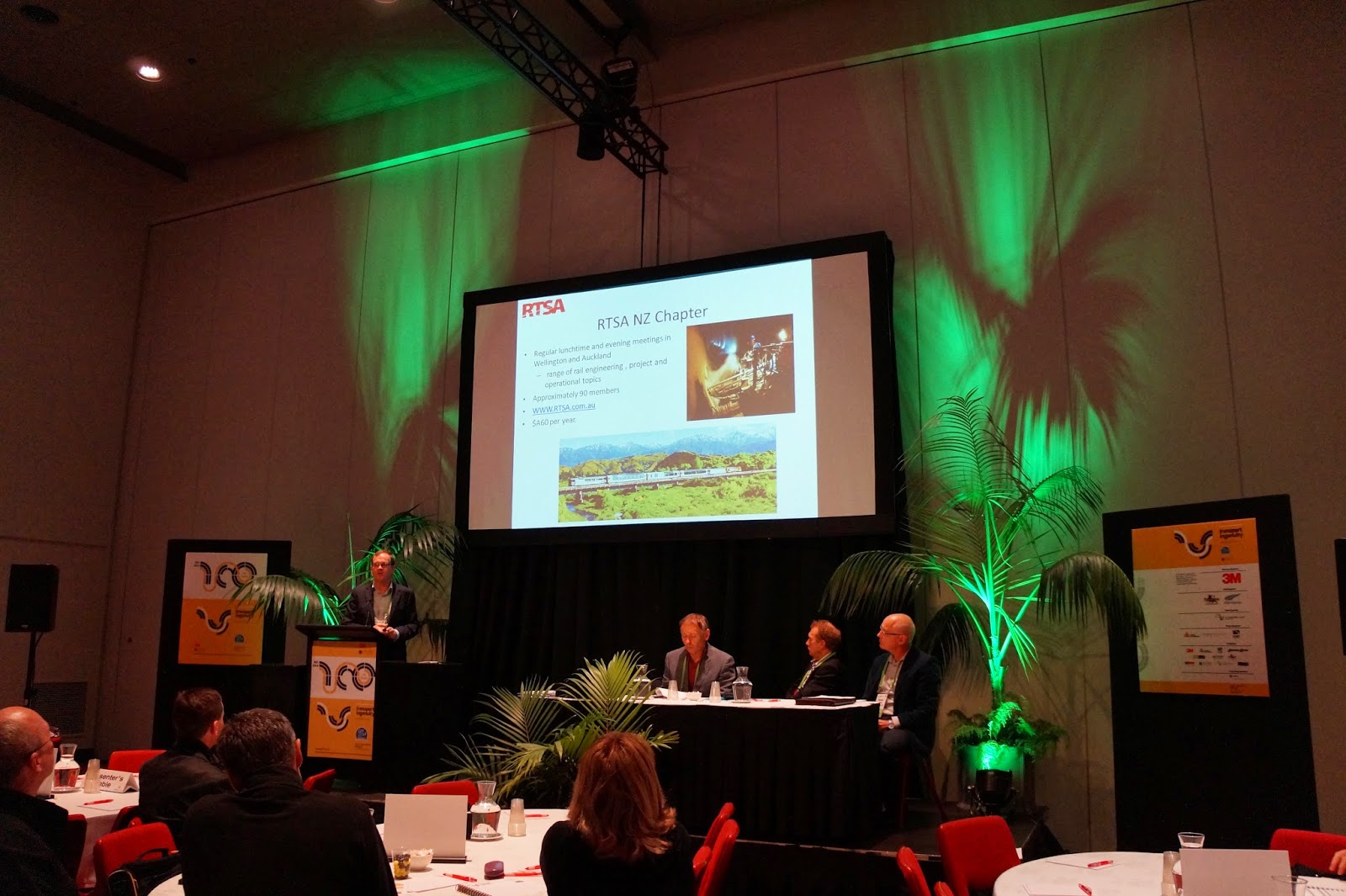
One of the morning streams was dedicated to the Railway Technical Society of Australasia a joint Technical Society of Engineers Australia and IPENZ New Zealand, formed to further the interests of the railway industry at large and its individual participants. With their upcoming conference CORE 2014 in Adelaide they are directed towards providing leadership for the facilitation and coordination of professionalism in the railway industry and the encouragement of member contributions to the application of railway technology and good management practices.


Michael McKeon from KiwiRai and then Randall Prestige from Target Railway Progress presented current and proposed New Zealand railway projects that will enable more efficient movement of freight and passengers across the country.


Overall the IPENZ Transportation Group 2014 conference was a great opportunity to learn about transport projects from the other side of Tasman sea. There are also  some good opportunities and ideas to enhance the collaboration between IPENZ and AITPM that are worth exploring the following days. I also found some good ideas that we can maybe adopt for our AITPM 2015 conference in Brisbane.

The quest for transport ingenuity is ongoing and more relevant now than ever in the history of 100 years of Engineers of New Zealand.

Tuesday, 25 March 2014

AITPM@IPENZ Day 3 - Freight, logistics and ... dogs.

Day three of the IPENZ Transportation award and as always with the conferences, people start to feel a bit tired and thinking of all the work that they have left behind.

Luckily there were a few interesting presentations starting with Geoff Dangerfield, CEO of NZ Transport Agency. Geoff presented the work that NZTA is doing to provide for transport solutions for today and tomorrow. He presented the “one network” thinking behind all NZTA actions and focused specifically on freight, where he described the agency’s goal for more freight on fewer trucks.
 
 
Of course he presented the already famous TV road safety ad, part of the wider Safer Journeys strategy.
 

One of the conference streams this morning was dedicated to the Signals NZ user group. The group has recently extended their activities to cover Intelligent Transport Systems to enhance people and freight movement through traffic control and ITS. An interesting fact from the presenters was that in New Zealand enforcement of red light cameras in not yet legal.

The organising committee has set aside some time in the program for delegates to have the chance to go through the “Active Poster Display”. Authors stood beside their posters and gave everyone the opportunity to ask questions and clarify things.
 

Another distinct stream of the day was the presentations of the Chartered Institute of Logistics and Transport a worldwide professional body with presence in more than 100 countries.
 

Finally the day closed with another fairly unique feature, the roundtable presentations. Seven different presentations were set up around tables and repeated three times with a duration of 25 minutes each. That gave the presenters the opportunity to have a true interaction with everyone witch worked quite well for most of them.
 
 
In the case of Jo Draper from NZ Transport Authority was a huge success, where she and her colleague Dean Ingoe from Auckland Transport presented the challenges behind stakeholder consultation on transport projects land acquisition and engaged us in a role playing game that helped everyone understand all the critical factors. As Jo said “when you visit people at their houses, beware, there is always a dog”

Monday, 24 March 2014

AITPM@IPENZ Day 2 - Is it all about perception?

Second day of the conference and it was time for papers, presentations and posters. But the start of the day had a bit of a surprise for all delegates. The fire alarm went off and everyone got out with no problems. The Fire Services arrived at the spot within a short time and it must have been something minor, cause a few minutes later we were allowed back in and the second day of the conference officially began.
 
 
Dr Soames Job from Global Road Safety Solutions delivered a very interesting presentation on the Safer Journeys Strategy. He put the emphasis on speed and stated that speed is “in the heart of safer systems”. He also commented on how we dramatically underestimate the role of speed in serious crashes. He said that all the research shows that when we lower speed limits, crashes go down. He ended his speech by saying: When it comes to speeding; Think publicly – act personally.
 
 
Malcom Douglass and Ron Fisher two of the older members of IPENZ transportation group presented the history of transport in NZ and the role of engineering inheritance. IPENZ celebrates 100 years of presence and the Transportation Group celebrates having more than a 1000 members.


3M one of the major sponsors of the conference had a short but very helpful contribution to the discussion at the conference. Michael Holderness revealed part of a wider research that shows that major improvements to signs can be made by simply cleaning them.
 
Shared spaces was a big part of the Active Travel session. Presenters from Auckland Transport and University of Auckland showed examples where shared space schemes were implemented in NZ.

 
A common theme on several presentations was the notion of perception. Presenters were talking about the perception of safety and about the perception of benefits or about the perceived cost for the user and how projects should include perception surveys. That made me wondering; are we focusing too much on perception?
 
The final presentation for the day came from Dave Ferguson. Dave leads the vision, learning and mapless driving team for Google’s self-driving car program. And while other companies are working on the same research topic that will make us all one day Knight Riders, it was impressive to see a blind person sitting on the driving seat of a self-driving Google Toyota Prius.


Sunday, 23 March 2014

AITPM@IPENZ Day 1

A few days ago, I had the pleasure and the honour to win the AITPM New Zealand Study Tour Award. This award gives the opportunity to an AITPM member to have the conference registration costs, reasonable travel & accommodation expenses to attend the conference and accommodation costs for an additional two days in the conference city fully paid by AITPM.

Wellington is a lovely city, relaxed but yet vibrant, with a very friendly atmosphere.

It kind of made me homesick as it reminded me a bit of Kavala. Harbour town build amphiteatrically around the water.

Wellington though, has some amazing museums with astonishing Maori art and artifacts.

The highlight of the CBD tour was the cable car ride. Wellington's cable car is more than 110 years old.

Networking with my New Zealand (and a few Australian) colleagues was fun with activities like the geocaching/ treasure hunt at Zealandia and a bridge building competition that proved that traffic engineers and transport planners are not only good in planning and designing bridges but also at building them.


This first day was very promising. I hope the rest of the IPENZ Transportation Group conference is as interesting and as fun.