Saturday, 6 September 2014

Investing in art: Personalised licence plates.


A few of the past posts in my blog were about the differences between Greece or Europe and Australia on transport and traffic issues. Traffic signs, tolling road infrastructure, roadside memorials and most recently World Cup logistics, my Greek origin and my Australian living allowed me to easily point out such differences. One of the first differences to spot, which I didn’t have the chance to write about, was personalised plates or vanity plates as they are also known.  Australia is one of the now many countries that allow vehicle owners to customise their license plates altering their colour, fonts, and even the numbers and letter on the plate. Greece on the other hand, allows only for standard license plates issued by the Ministry of Infrastructure, Transport and Networks that nowadays follow the EU standard for licence plates.


History of Greek Plates (source)
Slogans on the bottom of the plate, is another difference between the standard plates of Greece and Australia. In Australia similar to USA every state has it’s own slogan that is used as a promotional pitch. Queensland uses the trademark Sunshine State while a few years ago the plates wrote The Smart State. 

History of QLD plates (source)
Victoria has the Stay Alert Stay Alive slogan while the previous wrote The Place to Be , On The Move and Garden State. Currently New South Wales standard plates don’t have any slogan but in the past they used The Premier State, The First State and Towards 2000. South Australia also has no slogan but they used to have the slogan The Festival State. WA used to have the slogans State of Excitement, Home of the America’s Cup and The Golden State but they abandoned all slogans during the beginning of the 90’s.

Personalised plates come in a variety of forms, colours and slogans and they can be almost fully customised. Depending on one’s preferences, those plates can cost up to $3500 for a new one that spells KYRIAKO or $500 for an Endless Summer theme. From there, the laws of  free market can skyrocket the price of a plate. 

   
It has been reported that the owner of the Q1 plate, that is supposedly the most sought after plate in Queensland, refused an offer of more than a million dollars for his plate. The Q8 plate was in the market a couple of years ago and the auction close at $220,000 more than 17 times the amount the owner spent to buy it, back in 1988.

Personalised plates have now become more than another way of revenue for transport authorities around the world and a means to fund road safety projects, like we do in Queensland. They have become an investment similar to buying artwork. I am just wondering why Troika and the rest of Greece’s lenders haven’t requested this “reform” from the Greek government as a way to repay debt. But then again, with so many car owners handing back their plates because they can no longer afford having a car, or at least a licensed car, maybe the calculated revenue would have been very low.


Saturday, 2 August 2014

World cup team logistics. Flights and heat in Brazil part 2 and final.

The first part of this blog post, was about the Soccerroo’s choice for a base camp in Brazil and how that did not have a negative effect in the team’s performance, something that can be suggested though for Spain.  

Source
Greece participated in a football World Cup for the third time in its history. This time, people responsible for organizing the team’s logistics were more professional and prepared than they were back in 1994 in USA when Greece first participated in a world cup. For the base camp, the coach and his associates picked Aracaju the capital of Sergipe.  This was the second most northern base camp of all participating teams. Only Ghana chose to stay at a city further north, in Maceio. Aracaju a seaside Brazilian city, is known as the city with the healthiest lifestyle in the country and a national example for its bike paths. During the world cup, it was hot and very humid.

Greece played the first match against Colombia in Belo Horizonte which was quite cool compared to other Brazilian cities of the same latitude. The 852 metres elevation of Belo Horizonte keeps the city cool, suppressing high maximum air temperatures experienced in nearby cities at lower altitudes.  Colombia, not only had a great team but they are also quite accustomed to the Tierra caliente climate. Greece traveled 1243 kms (as the crow flies) to go from Aracaju to Belo Horizonte while Colombia travelled only 755 kms from their base camp in Sao Paulo. 

Source
Japan, that was on the same group, chose to stay in Sao Paulo, where the climate is much cooler and there is also a big Japanese community. In their second game against Greece they had to travel 2322 Kms to Natal while Greece had to travel just 605 Kms. The climate in Natal is quite warm at humid during June and July and while Greece was playing with 10 players for more than half the game, they seemed more energetic and managed to get a valuable 0-0 draw that proved to be critical for Greece to advance to the next round.   

Ivory Coast was the fourth team in the group and they chose to stay in Sao Paulo as well. That meant that along with Japan they traveled the most kms between their camp and the host cities for the group matches. Ivory Coast traveled 6670 Kms and Japan 7172 kms. That is more than twice the distance that Greece (3152 kms) or Colombia (3338 kms) had to travel. The last and crucial match for Ivory Coast against Greece was played in Fortaleza at 17:00 local time. Greece traveled 816 Kms from Aracaju while Ivory Coast traveled almost three times more (2370). While the African players were considered superior in strength and speed, Greece managed to be competitive all the way till the last minute and scored the winning goal that allowed them to go through to the stage of 16.

Source
My conclusion for this group was that team logistics played some role here too. Greece benefited from their base camp choice while Japan and Ivory Coast did not, in fact they probably were hindered. 

Other notable failures in this world cup were Italy and the USA team. USA traveled the most kms of all 32 teams (8886) while Italy was close with 8458 kms. 

Source
While I was never a fan of the German team, it’s only fair to close this blog post with their accomplishment in this last Mundial. They were the most prepared and organized team in this competition, not only from an athletic point of view but also for the team logistics. They picked a relatively north location in Bahia and arranged for a fit for purpose, newly built just for them, base camp. Campo Bahia  a new resort constructed at an area with a climate similar to those where the team’s matches were played, included 14 two-storey housing units, a training pitch, team headquarters, and a fitness center. It has been reported that a German investor has helped to fund the £25 million project. Germany was one of the top five teams with the less kms traveled (fourth with just 2114) at the Group stage. Interestingly Argentina that also made it to the World Cup final was third with just 2086 kms.

Wednesday, 30 July 2014

World cup team logistics. Flights and heat in Brazil part 1.

I  was writing on my last post about the world cup in Brazil and all the transport projects that were not delivered in time. It seems that in this world cup there was another transport aspect that affected the whole competition: Team logistics.

Source
 Brazil is a huge country, even larger than Australia. In fact it is around 10% larger than Australia with almost 10 times more population. Being closer to the Equator than Australia, it means that weather differences between Brazilian cities in the north and the country's cities to the south, are even more significant that the differences between Cairns and Adelaide.  Twelve Brazilian cities hosted world cup games, from Fortaleza and Natal up near the Equator, to Porto Alegre the southernmost Brazilian city at a latitude similar to Brisbane's. And from Manaus at the middle of the Amazon jungle again near the Equator to Salvador at the east coast at a latitude near that of Torres Strait islands. 
   
Source
The other critical issue with the team logistics was the fact that as most world cups due to tv coverage all 32 teams had to play each one of their three group stage matches in different stadiums, in different host city. This meant they had to adapt to different climates and weather conditions and to be able to tolerate long distance flights between their camp base and the host city they were playing each time.

So choosing the right base camp was more important this time than other similar competitions. I remember for Euro 2008 that I had the pleasure to watch Greece's stage round (although Greece didn't go that well that time), Greece played all their games in Salzburg, Austria and the other games of the group were played in Innsbruck, Austria two hours’ drive away. So let’s see if selecting the right camp played a role on the team’s performance. I will examine Australia and Greece, the winner Germany and some notable failures.
FIFA and the organisers have prepared a brochure with 83 different available locations for teams to select their base camp. There was plenty of information there, about weather conditions, distances to the host cities, available accommodation choices with the details of offered amenities and much more.

Australia chose to set camp at Vitoria and journalists in the country were quick to determine this as a big win. This was further north than what most of the teams competing in Brazil chose. Around 400 km north of Rio de Janeiro and on the Atlantic Coast, Vitoria appeared to be (and in fact it is) a quiet, beautiful city with great accommodation for the team and fairly good accommodation for the huge number of Australian fans that traveled to Brazil to attend the games. Australia was in Group B so the team had to play the first game against Chile, on June 13 at 18:00 in Cuiaba at the center of Latin America. Cuiaba is some 1075 km away from Vitoria with a total flight time between them at around 2 hours and 45 minutes. Chile had camp at Bello Horizonte, closer to Cuiaba than Vitoria and while Vitoria is usually warmer and more humid in June than Belo Horizonte is nowhere near as hot as Cuiaba. 

Source
 Second match for Australia was on June 18 against Netherlands in Porto Alegre and the third and unfortunate last match was in Curitiba. Porto Alegre and Curitiba, being in the south of the country had similar weather conditions much cooler than Vitoria and at least a couple of hours away. Netherlands stayed in Rio which is somewhere in the middle between Vitoria and Curitiba where Spain decided to stay. 
Looking at the distances the four teams covered between matches, Australia covered the most at 4320 kms, almost 50% more than Chile that traveled only 2830 Kms. The match that decided the fate of this group was played in the afternoon (16:00) of June 13 between Spain and Netherlands in Salvador. Spain seemed to have big problems with the heat and humidity on the day while the Dutch seemed more prepared having their camp in the slightly warmer Rio de Janeiro. My conclusion for Group A logistics; Australia did well with their selection even having to travel the longest distances. After all, Australians are accustomed to long flights. Spain was the big losers in the logistics game. They chose a cool camp in Curitiba but that suit them well only against Australia. Unfortunately, by then it was too late. They could not recover from the shock of the heat wave in Salvador.

My next post will examine how Greece handled their logistics and what the Germans did and if that led to their success. 

Monday, 23 June 2014

World cup in Brazil. Stadiums instead of public transport.

I am a huge fan of football or soccer as it is called in the English speaking world. Unfortunately Brazil is a long way from Brisbane and as much as I would love to be able to watch Greece or Australia play at the world cup, unfortunately I had to watch the games on TV.


The Mundial as I've learned to know the world cup from my youth, as all huge sport competitions has also a transport and traffic side. As in the London Olympic games in 2012, the organizers have to plan an effective way to move tens of thousands of people to and from the venues safely. The big difference of the world cup from the Olympic games, is that the world cup is hosted across a whole country and there is only one game at a time while the Olympic games are hosted around a city (and a bit further out) with lots of different games and sports happening at the same time. The Olympic games are much bigger competition from a transport and traffic point of view but the transport task of the Mundial is quite significant as well.

Brazil promised FIFA and the Brazilian people a series of upgrades on it's infrastructure. And while FIFA, which is accused for corruption cared more about the new stadiums like the new Sao Paolo arena, the carrot for most Brazilians was the upgrades to transport infrastructure. A series of transport projects like upgrades to airports and new light rail systems were planned to be delivered supposedly just before the first whistle of the referee in the game of Brazil against Croatia.

In reality Brazil ended up spending a huge amount of money and failed to deliver a lot of the transport infrastructure upgrades that it promised. The light rail in Cuiaba where Australia played the first game against Chile, was meant to help soccer fans get around but was not ready in time. Instead, the new light rail line from the airport into the city runs for just 500 metres until it disappears completely.
And there are a lot of other traffic and transport related issues that add to Brazilians' disappointment and frustration.

Traffic congestion and gridlocks around stadiums is a regular phenomenon and that caused a number of fans to miss the opening minutes of matches. Even the second best football player of all times, missed the first half of the opening game between Brazil and Croatia, held up in traffic.

Fans in Brazil, also experience big delays at airports, as the network capacity can not cope with all the demand and a lot of the airport upgrades were not delivered in time. And then there are those unlucky fans that were delayed in air traffic just because elected politicians want to demonstrate their country's superiority through sports.

All these traffic problems, along with massive hikes in public transport fares and extreme poverty led to protests, especially on the transport sector and clashes with the police.

Next time we take a break at the game's half-time, let us take a moment and ask a simple question like the kid on the photograph. If people don't even benefit from the infrastructure upgrades of such sport events, then what's really left?


Wednesday, 28 May 2014

Flying around Australia

Lately I've been busy with meetings around Australia and that meant I would have again the opportunity to observe transport systems around air travel.

My flight to Rockhampton was very early in the morning so I had to catch a taxi to Brisbane airport. I called the taxi company on the phone that I've found on the net and a few minutes later there was a Toyota Prius taxi waiting for me outside my house. The drive was a breeze as it was pre peak hour and the taxi driver asked me if I wanted to go via the tunnels which I decline due to tolls and low traffic.

Rockhampton airport is not big but it is well organised and modern. Rental cars are located just in front of the entrance to the terminal. Your other options are either taxi or a bus service to the city.

Rocky, as the locals and other Queenslanders call Rockhampton, is the beef capital of Australia. Beef is celebrated everywhere with numerous bull statuses around the city.


A few days later, I had to fly to Melbourne. This time, the flight was in the afternoon so I had some time to catch the Airtrain rather than a taxi, as they can be very expensive. For a cost of around $15 you arrive 20 minutes later at Brisbane Airport. The train service is of a high level with the only problem that it stops at 22:00 and leave the late night flights without coverage.

In Melbourne for around the same money and the same travel time you get to go to from Melbourne Airport to your hotel in Melbourne CBD by buses.  Skybus is an outstanding bus service that not only connects Tullamarine Airport to the CBD but also delivers you to your hotel door (or close) for the same price that takes the rest of the passengers just to Kings Cross station.


I was quite surprised when I arrived at Kings Cross station, as the lady that sold me the return ticket at the airport booth didn't say anything for the hotel part of the trip. I felt like I was at an asian capital. A number of small buses like the one in the picture above and drivers hanging outside the ticket office. I guess we do learn some things from our asian neighbours. The best part is that even on the return trip you can arrange to be collected outside your hotel in the CBD. And all these without really asking for hotel reservation papers or anything.

Transport systems that support city airports are a critical link to the city's overall transport system. For the visitors it's often the first impression that they get. A frequent and well operated public transport system that connects the airport to the city is crucial especially to cities that have a tourism focus.

Tuesday, 29 April 2014

The last text.


This is not the first time that I write on my blog about texting and driving. The previous time, I wrote that this is a very unsafe practice and it is usually OMG and not LOL. But reading the news today I was once again shocked. This resembles a Greek tragedy: A 32 year old woman has died in a head-on collision on a US highway just seconds after she posted selfies and updated her status on Facebook, according to the police. The tragic part of the story is that the woman was listening to the “happy song” and her last (typed) words were: "The happy song makes me so HAPPY."

This takes the whole distraction while driving issue to a different level.  The crash statistics of texting and driving are nowadays well documented and the facts say that this is quite a common practice among drivers, especially among young drivers. It seems though that there is still a lot to be done. 
There is a lot to be done in terms of driver education. A lot of campaigns focus on speeding, like the “Join the drive” campaign that Queensland government launched before Christmas and kept it going during this last Easter period due to its big success.


I remember that at first, the whole discussion was about driving and talking on the mobile phone. After a few years and as the mobile phones evolved from the first generation almost primitive ones - good only for talking - to the new smartphones that you can send SMSs, connect to Facebook, check and respond to emails and even read a book, the driver distraction problem got much worst. 


There is also a lot to be done it terms of technology. Apple seems to be realizing the depth of the problem and just yesterday has announced that has filed a patent application for a system that could bar access to an iPhone’s messaging apps while a user is driving.
There is a lot to be done in terms of enforcing. While the road rules covers this topic quite adequate, It seems that it is not a top priority for police to target texting and driving.  Just a few days ago a West Australian police officer was photographed using his mobile phone while driving. As a reaction WA police have launched their Easter road safety blitz with a show of force designed to deter distracted drivers from picking up the phone while behind the wheel. That included the use of unmarked motorcycles to crack down on texting drivers.


At my previous post I was asking: Why can't we just do the right thing and don’t use the mobile phone while we are driving?  Why do we prefer OMG rather than LOL? It seems that we are way beyond this point. There is no time anymore to waste on asking theoretical questions. It is time to act. Everyone on his own and the responsible organisations and governments on a structured and effective way. 

Wednesday, 26 March 2014

AITPM@IPENZ - Last day. Ingenuity now more than ever.

Last day of the conference and I am happy to report on the conference proceedings back from Brisbane. I fully enjoyed my stay in Wellington but... give me Brisbane any day.

The conference day kicked of with keynote speaker Steven Newman, CEO of EROAD. I was hoping that Steven will speak about the work he did on road charging but Steven preferred to speak about future transport systems or as he called it super intelligent transport systems.

The second keynote speaker for the day was Rob Merrifield. Rob has worked for more than 50 years on road construction and management but his passion was always studying the historic development of transportation. From the Diolkos and the other ancient Greek rutways to the 1834 Newcastle upon Tyne railway and other tramway systems in England it seems that archeology takes more and more interest in transport systems of the past.


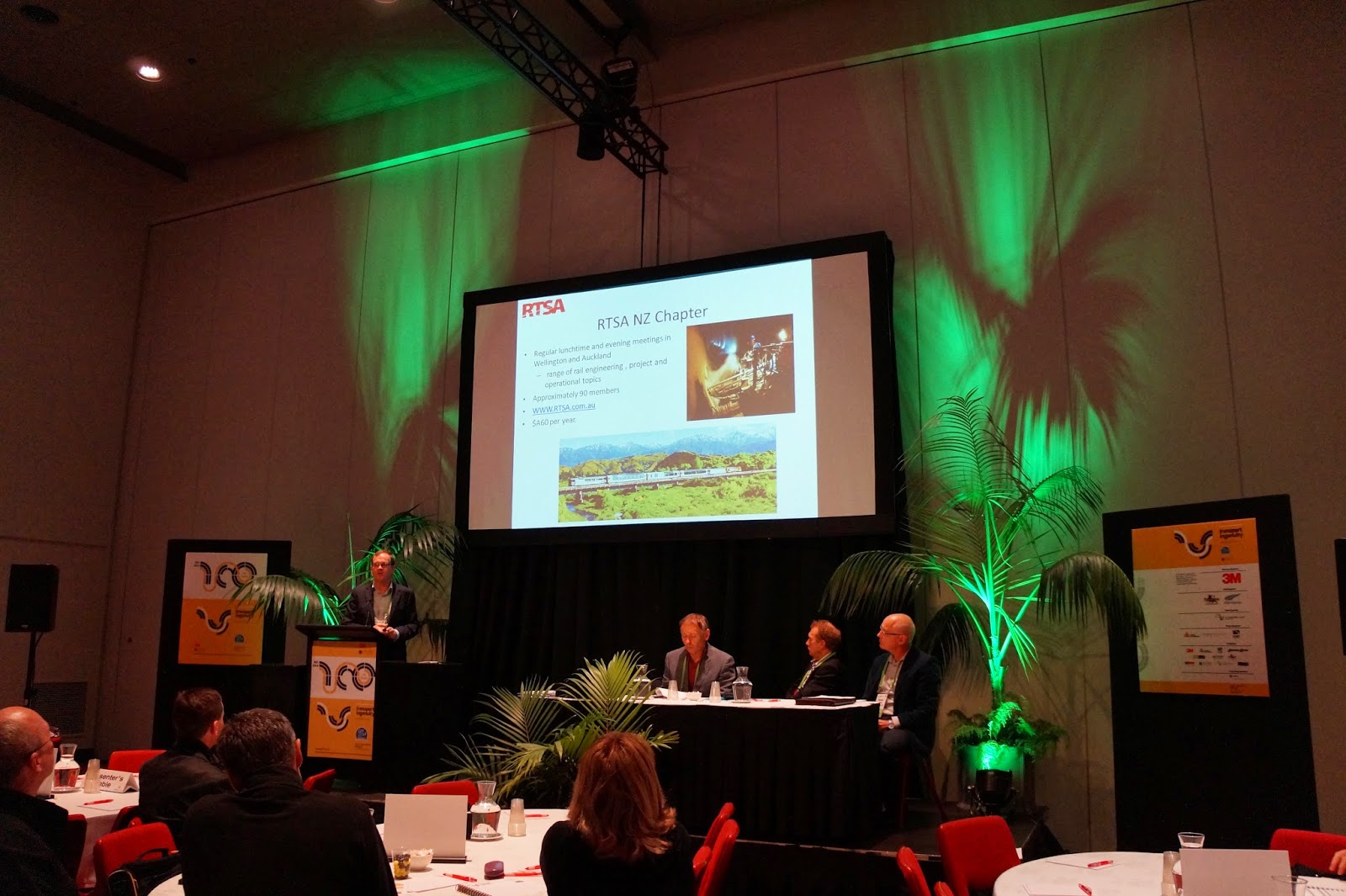
One of the morning streams was dedicated to the Railway Technical Society of Australasia a joint Technical Society of Engineers Australia and IPENZ New Zealand, formed to further the interests of the railway industry at large and its individual participants. With their upcoming conference CORE 2014 in Adelaide they are directed towards providing leadership for the facilitation and coordination of professionalism in the railway industry and the encouragement of member contributions to the application of railway technology and good management practices.


Michael McKeon from KiwiRai and then Randall Prestige from Target Railway Progress presented current and proposed New Zealand railway projects that will enable more efficient movement of freight and passengers across the country.


Overall the IPENZ Transportation Group 2014 conference was a great opportunity to learn about transport projects from the other side of Tasman sea. There are also  some good opportunities and ideas to enhance the collaboration between IPENZ and AITPM that are worth exploring the following days. I also found some good ideas that we can maybe adopt for our AITPM 2015 conference in Brisbane.

The quest for transport ingenuity is ongoing and more relevant now than ever in the history of 100 years of Engineers of New Zealand.